Playbook · · 8 min read
Ecommerce Conversion Optimization in the Age of AI: Why Traditional CRO Fails AI-Referred Visitors
By Itamar Weisbrod
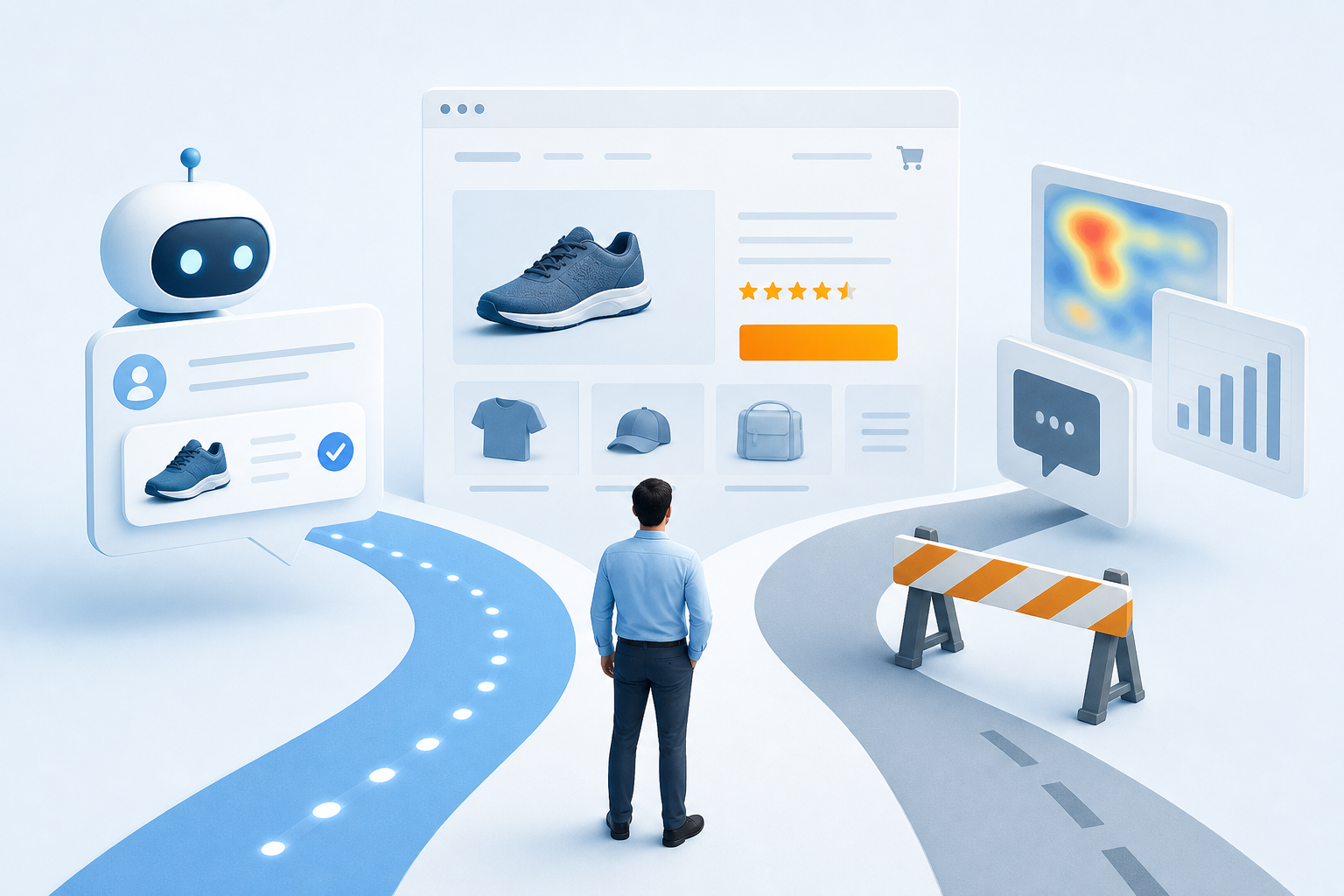
Your A/B test results look fine. Your page speed scores are clean. Your checkout funnel has been tightened three times in the past year. And your conversion rate is still flat.
If that describes your situation, the problem may not be your pages. It may be who is arriving on them.
A growing share of your traffic now comes from AI assistants: ChatGPT, Perplexity, Gemini, Claude. These shoppers arrive differently than organic or paid visitors. They arrive mid-conversation. And the standard toolkit for ecommerce conversion optimization was not built for that.
What Traditional CRO Assumes
Conventional conversion rate optimization rests on a few assumptions that have held up reasonably well for a decade.
The first: visitors arrive with incomplete information and need to be educated. So you write better product descriptions, add comparison tables, and surface reviews.
The second: friction is the enemy. Reduce clicks to checkout, simplify forms, speed up load times.
The third: the page is the conversation. Get the copy, layout, and social proof right, and the page does the persuasion work.
All three break down with AI-referred visitors.
How AI-Referred Visitors Actually Arrive
When a shopper asks ChatGPT "what's the best collagen supplement for someone over 40 who doesn't want a chalky taste," they get a specific answer, often with reasoning attached. By the time they click through to your site, they have already formed a mental model of what they are looking for and why your product might fit.
They are not arriving to be educated. They are arriving to confirm, compare, or complete.
The click happened. The sale did not. That gap is where traditional CRO has no answer.
Your static product page was written for a visitor still in discovery mode. It leads with benefits, builds context, and eventually reaches the specific claims that matter. An AI-referred shopper often already has that context. What they need is confirmation on the specific question the AI raised: Does this formula include X? How does it compare to Y? What happens if it doesn't work for me?
If your page doesn't answer that question, they leave. Not because your page is bad. Because it was written for a different visitor.
The Engagement Data Is Not Subtle
AI-referred visitors demonstrate meaningfully higher engagement than organic traffic. That is not a small signal. It means they are arriving with more intent, not less.
The conversion problem is not a demand problem. It is a mismatch problem. High-intent shoppers are hitting pages that cannot continue the conversation the AI already started.
Adobe Analytics tracked AI-driven referrals to retail sites growing roughly 10x between mid-2024 and early 2025. That volume is not going to shrink. The question is whether your pages are equipped to handle it.
Where Standard CRO Tactics Fall Short
Heatmaps and click data tell you what happened, not why
A visitor who arrived expecting an answer to a specific question and didn't find it looks like any other bounce in your analytics. They scroll partway down the page, skip the add-to-cart button, and leave. Your heatmap shows a drop-off. Your session recording shows hesitation. Neither tells you the question they arrived with.
You cannot optimize for a question you cannot see.
A/B testing optimizes for the average visitor
Split tests improve performance across the full distribution of visitors. If AI-referred shoppers represent 15 percent of your traffic but have meaningfully different needs, the winning variant will still be calibrated for the other 85 percent. The AI-referred segment gets averaged out.
Chat widgets on static pages are reactive, not conversational
Adding a chat overlay to a product page is not the same as building a conversational experience. Most chat implementations trigger on exit intent or after a delay. They are designed to catch visitors who are already leaving. An AI-referred shopper who arrives with a specific question, finds a static page, and spots a chat bubble in the corner is not going to feel like their conversation is continuing. It is going to feel like a dead end with a popup.
The Structural Gap
The deeper issue is that your existing site was built for a world where the conversation starts on your pages. Navigation, category structure, product copy, FAQs: all of it assumes the shopper is building their understanding from scratch.
AI assistants have changed where the conversation starts. It starts in the assistant. Your site is now the second stop, not the first. And the second stop needs to pick up where the first left off.
That requires something your current site architecture was not designed to provide: a surface that can receive a visitor mid-conversation and respond to what they already know and what they still need to confirm.
This is not a copy problem. It is not a UX problem. It is an architecture problem.
For a closer look at how this plays out specifically for Shopify merchants, converting AI search visitors without rebuilding your store covers the practical options.
What Ecommerce Conversion Optimization Looks Like Now
Optimizing for AI-referred visitors requires a different starting point: knowing what questions they are actually arriving with.
That is not a hypothetical. The questions are observable. AI assistants generate consistent patterns of follow-up intent for specific product categories. A shopper referred by Perplexity for a skincare product is likely asking about ingredient compatibility, skin type fit, or return policy. A shopper referred by ChatGPT for a supplement is likely asking about dosage, interaction risks, or sourcing.
If you do not know which questions your AI-referred visitors are arriving with, you are optimizing blind.
The second requirement is a surface that can answer those questions conversationally, not a page that lists information in a fixed order. Static pages are not wrong. They are just incomplete for this use case. A shopper who arrives with a specific question needs to be able to ask it and get a direct answer, not scroll through a product description hoping the answer appears somewhere.
The third requirement is continuity. The experience should feel like a continuation of the conversation the shopper started with the AI, not a reset. That means the tone, the information, and the flow need to match what the AI already told them.
The Parallel Site Approach
One architecture that addresses this directly is a parallel agentic site hosted on a brand-owned subdomain, built specifically to receive AI-referred traffic. Rather than retrofitting a static site with chat widgets, this approach creates a separate conversational layer that can hold a natural language dialogue with shoppers, answer product questions, and guide them toward a purchase decision.
Aigency builds this kind of parallel site using vision-based crawling agents that read your existing site the way a human visitor would. No code integration, no database access, no IT involvement required. The result is a site at ai.yourbrand.com that can continue the conversation an AI assistant already started, for both AI-referred human shoppers and autonomous agents acting on a shopper's behalf.
The platform includes a free site scan that surfaces the specific questions AI-referred visitors are asking that your existing pages fail to answer. That gap report is useful on its own, regardless of what you do next. It tells you exactly where your current pages are falling short for this traffic segment.
For operators who want to understand how this fits with an existing commerce stack, how Aigency fits into your Shopify or headless setup explains the architecture without requiring a sales conversation first.
What to Actually Do With Your CRO Program
Traditional CRO is not obsolete. Page speed, checkout friction, and social proof still matter for the majority of your traffic. The argument here is not to abandon what works.
The argument is to stop applying the same tools to a visitor segment they were not designed for, and to start treating AI-referred traffic as a distinct cohort with distinct needs.
Practically, that means:
- Segment your analytics to isolate AI-referred visitors. Look at their bounce rates, time on site, and conversion rates separately from organic and paid traffic.
- Identify which pages they land on and what questions those pages do not answer.
- Decide whether your current static pages can be updated to address those questions, or whether the volume and complexity of AI-referred traffic justifies a dedicated conversational surface.
The data on AI-referred visitor intent is clear enough that ignoring this segment is a choice with a measurable cost. For more on what that traffic actually looks like and why it behaves differently, AI search traffic and why ChatGPT visitors convert differently covers the mechanics in detail.
If you want to see exactly which questions your AI-referred visitors are asking that your pages do not answer, the free site scan at aigency.ai generates that report for your specific site.
Frequently Asked Questions
What is the difference between AI-referred visitors and organic search visitors? Organic search visitors typically arrive in early discovery mode, having found your site through a keyword query. AI-referred visitors arrive after an AI assistant has already answered part of their question and recommended your brand. They carry more specific intent and often need confirmation on a narrow set of questions rather than a full product education.
Why do traditional CRO methods underperform for AI-referred traffic? Standard CRO tools like A/B testing, heatmaps, and exit-intent chat are calibrated for the average visitor across all traffic sources. AI-referred visitors have different behavior patterns and different informational needs. When they are a minority of total traffic, their specific needs get averaged out in test results and analytics, making the problem invisible until you segment explicitly.
How do I know if AI-referred traffic is a meaningful share of my visitors? Check your analytics for referrals from chat.openai.com, perplexity.ai, gemini.google.com, and claude.ai. Many operators are surprised to find this segment already represents several percent of total traffic, and growing. Even a small share matters if those visitors have higher purchase intent than your average visitor.
Can I fix this problem by updating my existing product pages? Sometimes. If the gap is a handful of specific questions that come up repeatedly, updating your FAQ sections or product descriptions may be enough. If AI-referred visitors are arriving with highly varied, conversational questions that depend on context, a static page update has a limited ceiling. The right answer depends on your specific gap data.
What does a conversational surface for AI-referred visitors actually look like? It is a site that can receive a natural language question and give a direct, accurate answer based on your product catalog and policies. It is not a chatbot overlay on a static page. It is a purpose-built layer that can continue a conversation mid-stream, answer comparison questions, handle objections, and guide a shopper toward a purchase decision without requiring them to navigate a traditional page structure.
Does this require rebuilding my existing site? No. The parallel site approach keeps your existing site intact. A separate conversational layer is hosted on a subdomain and handles AI-referred traffic specifically. Your main site continues to serve organic, paid, and direct visitors as it always has.
How do I identify which questions AI-referred visitors are asking that my pages do not answer? The most direct method is running a site scan that analyzes your pages against the actual questions AI assistants are generating for your product category. Aigency's free site scan does this and returns a specific gap report for your site, showing exactly where your current pages fall short for this traffic segment.