Playbook · · 12 min read
Agentic Commerce Guide for Mid-Market Ecommerce Brands 2026
By Itamar Weisbrod
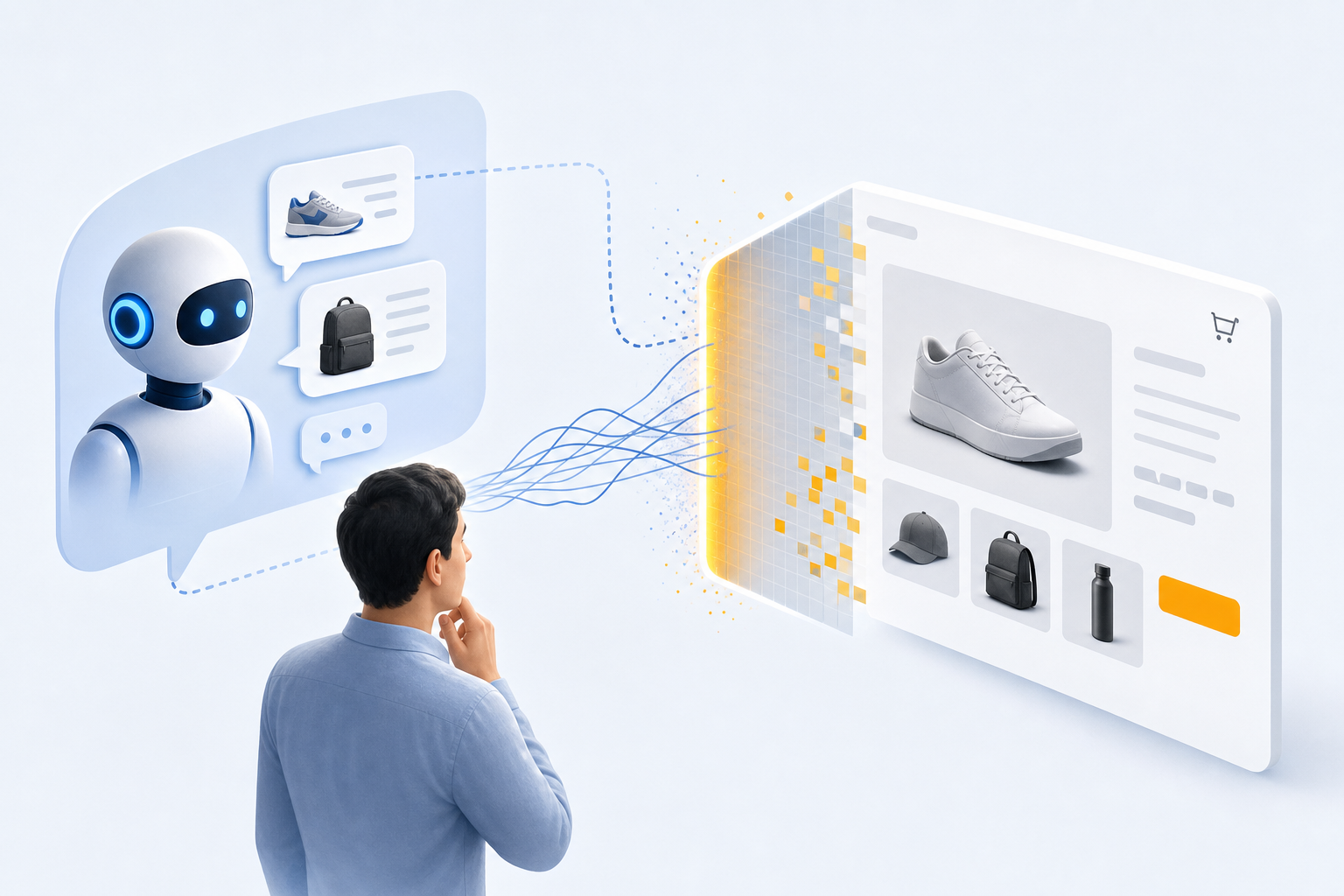
Agentic commerce is no longer a conference topic. In 2026, it is a category with real infrastructure, real traffic implications, and real consequences for mid-market brands that have not yet decided how to respond. This guide is written for operators running DTC brands in the $1M to $20M revenue range who are seeing AI referral traffic in their analytics and trying to understand what to do about it.
The short version: the problem is not that AI assistants are sending you traffic. The problem is what happens after the click.
What Agentic Commerce Actually Means
Agentic commerce describes the conditions in which AI systems, whether shopping assistants used by humans or autonomous agents acting on a user's behalf, participate directly in product discovery, evaluation, and purchase.
This is not a single technology. It is a structural shift in how shoppers find and buy things.
A shopper asks ChatGPT which SPF moisturizer is best for combination skin. The assistant recommends your brand and includes a link. The shopper clicks through. They land on a static product description page that does not answer the follow-up question forming in their mind right now: "But does it work under makeup?" The page cannot hold that conversation. The shopper leaves.
The click happened. The sale did not.
That gap, between the conversation an AI assistant already started and the static page your brand serves, is the core problem agentic commerce infrastructure is built to solve.
Why Mid-Market Brands Are the Most Exposed
Enterprise brands have engineering teams that can build custom solutions. Early-stage brands often have simple catalogs and short consideration cycles. Mid-market brands, roughly $1M to $20M in annual revenue, are caught in the middle.
You have enough product complexity that shoppers ask real comparison questions. Skincare routines, supplement stacks, apparel sizing, home goods compatibility. These are not "add to cart" decisions. They are considered purchases that require answers.
At the same time, you likely do not have a developer available to rebuild your storefront around AI-native infrastructure. Your team is two to fifteen people. Your stack is Shopify or a headless setup you spent real money on and are not about to replace.
The traffic problem compounds this. AI-referred visitors arrive with higher intent than most channels. They have already been through a conversation with an assistant that recommended your brand specifically. They are not browsing. They are evaluating. And they are landing on pages that were designed for a different kind of visitor.
The Three Layers of Agentic Commerce Infrastructure
Understanding what you actually need requires separating three distinct layers that vendors frequently conflate.
Layer 1: Visibility
Can AI assistants find and cite your brand at all? This is the generative engine optimization (GEO) problem. If ChatGPT or Perplexity does not surface your brand when a shopper asks a relevant question, the rest of this conversation is moot.
AI-visibility trackers help you monitor whether your brand appears in AI-generated responses across ChatGPT, Perplexity, and Google's AI Overviews. Getting cited is the prerequisite. It is not the destination.
Layer 2: Conversion
Once a shopper arrives from an AI assistant, can your site continue the conversation? This is where most mid-market brands have nothing. Static product pages were built to rank in Google and convert visitors who arrived from search. They were not built to receive a visitor who already has a specific, nuanced question and needs a direct answer before they will buy.
This is not a content problem. It is a structural problem. You can add more copy to a PDP and still fail this visitor, because the format is wrong, not just the words.
Layer 3: Agent Readiness
As autonomous shopping agents, software that browses and transacts on a user's behalf, become more capable, your site needs to be readable and actionable by machines as well as humans. Structured data, machine-readable product attributes, and clear navigational logic all matter here.
Most mid-market brands have some Layer 1 investment through SEO and GEO content. Almost none have addressed Layer 2. Layer 3 is still early-stage for most of the market.
For a fuller treatment of where agent-driven transactions actually stand in 2026, the agentic commerce myth and what WebMCP signals about the next two years is worth reading before you make infrastructure decisions.
Why Static Pages Fail AI-Referred Traffic
The mismatch is architectural, not editorial.
A shopper referred by an AI assistant arrives mid-conversation. The assistant has already established context: the shopper's skin type, their budget, their concern about fragrance sensitivity. Your product page has no access to that context. It presents the same information to every visitor in the same format.
The visitor needs a response, not a page. They need the equivalent of a knowledgeable salesperson who can say: "Yes, this works under makeup. The texture is light enough that it layers well. If you are sensitive to fragrance, the unscented version is the one to choose." Your PDP says "lightweight formula" and lists the ingredients.
That is not a failure of copywriting. It is a failure of format.
Chatbot engagement layers, the widget-based chat tools that sit on top of existing storefronts, partially address this. But they inherit the same limitation: they are overlaid on a page that was not designed for this visitor. They also require platform integration and ongoing maintenance.
The structural solution is a separate, AI-native surface that receives AI-referred traffic and is built specifically to hold a conversation from the first moment of arrival.
What an Agentic Storefront Actually Requires
If you are evaluating agentic commerce infrastructure, here is what the solution needs to do, functionally.
Hold a natural language conversation. Not a scripted FAQ. A genuine back-and-forth that can handle follow-up questions, comparisons across products, and edge cases specific to your catalog.
Stay on brand. Visual identity, tone, and product positioning should match your main site. A parallel surface that looks and sounds different from your brand creates trust problems.
Reflect current inventory and content. If you update pricing, discontinue a product, or change a formulation, the agent surface needs to know. Stale information is worse than no information.
Give operators control. You need to define what the agent can say, what it must never say, and where it sends users. An agent that goes off-script, makes claims you cannot support, or routes users to the wrong place creates liability, not value.
Require no replatforming. A solution that requires migrating your commerce stack is not a solution for a 10-person team. The infrastructure needs to layer onto what you already have.
Aigency is built around exactly this set of requirements. It deploys a parallel agent site on your own subdomain (ai.yourbrand.com) using vision-based crawling agents that read your existing site the way a human visitor would, with no code integration, no database access, and no developer involvement required. The surface serves AI-referred human shoppers, autonomous agents transacting on a user's behalf, and crawlers that scan your site before any human arrives.
The Style Agent extracts your visual identity so the parallel site stays on brand. The Monitoring Agent watches your main site and updates the agent site automatically when content changes. The Policy and Control Agent lets you define guardrails over what the agent says and where it directs users. Visual search allows shoppers to find products by uploading a photo.
The entry point is a free site scan that surfaces the specific questions AI-referred visitors are asking that your current pages cannot answer. That report is concrete and brand-specific, not a generic audit. It makes the gap measurable before you commit to anything.
You can start at aigency.ai.
The Headless Commerce Question
A common question from mid-market brands running headless stacks: does agentic infrastructure replace headless, or complement it?
They solve different problems. Headless commerce separates your frontend presentation from your backend commerce logic, giving you flexibility over how your storefront looks and behaves. Agentic infrastructure adds a conversational layer designed to receive and convert AI-referred traffic.
They are not in competition. A headless stack does not automatically make your site capable of holding a natural language conversation with a shopper. And agentic infrastructure does not replace the need for a reliable commerce backend.
The longer version of this question, including when headless is the right call and when it is not, is covered in detail in Headless Commerce in 2026: When It Makes Sense and When Agentic Infrastructure Is a Better Fit.
What an Agentic Website Looks Like in Practice
The term "agentic website" gets used loosely. In practice, for a mid-market DTC brand, it means a site surface that can do three things a standard ecommerce site cannot.
First, it receives a visitor with context. The agent knows the visitor arrived from an AI assistant and can meet them where the conversation left off, rather than starting from zero.
Second, it generates responses rather than retrieving them. Instead of matching a query to a static page, it constructs an answer from your product catalog, your brand guidelines, and the specific question being asked.
Third, it produces conversational data. Every question a shopper asks is a signal about what your catalog needs to explain better, what objections are blocking purchase, and what your AI-referred visitors actually care about. That data is valuable beyond the individual conversion.
The implications of that third point, specifically the conversational data mid-market brands are currently giving away by not capturing it, are explored in What It Means to Have an Agentic Website in 2026.
GEO and LLM SEO: The Upstream Dependency
Agentic commerce infrastructure converts AI-referred traffic. But it cannot create that traffic if your brand is not being cited by AI assistants in the first place.
This is why GEO and LLM SEO are upstream dependencies, not alternatives to agentic infrastructure. If you are not yet appearing in AI assistant responses for relevant queries, the conversion layer is premature. Get cited first.
The practical steps for getting your brand into AI assistant recommendations, including how LLMs decide what to surface and what your product pages need to communicate to be cited accurately, are covered in the LLM SEO complete guide for ecommerce.
The sequencing matters. Visibility, then conversion, then agent readiness. Most brands are behind on step one and have not started steps two or three.
How to Prioritize in 2026
Start with your GA4 data. Segment by referral source and look for traffic from ChatGPT, Perplexity, Claude, and Gemini. If you are seeing it, you have a conversion problem right now. If you are not, you have a visibility problem that precedes everything else.
If AI referral traffic is present, run a site scan to understand what questions those visitors are asking that your current pages cannot answer. That gap report tells you whether you need a conversational surface or whether better content on existing pages would close most of the gap.
If the gap is structural, not editorial, you need a parallel agent surface. Not a chat widget. Not more copy on your PDPs. A surface built to receive and convert this specific type of visitor.
If you do not yet have meaningful AI referral traffic, invest in GEO and LLM SEO first. Build the citation surface before you build the conversion surface.
The Practical Priority Right Now
AI-referred traffic is growing. The consideration cycles for mid-market DTC products are exactly the kind of conversations AI assistants are built for. Brands that build conversational infrastructure now will have a compounding advantage over those that wait for the category to mature.
The practical priority right now is not rebuilding your storefront. It is adding a parallel layer that converts the AI-referred traffic you are already receiving, or will be receiving shortly, without touching your existing site.
Start with the free site scan at aigency.ai. It tells you specifically what your AI-referred visitors are asking and what your current pages fail to answer. That is the data you need to make this decision.
Frequently Asked Questions
What is agentic commerce? Agentic commerce describes the conditions in which AI systems, including AI assistants used by human shoppers and autonomous agents acting independently, participate in product discovery, evaluation, and purchase. It is not a single technology but a structural shift in how buying decisions get made.
Why does agentic commerce matter specifically for mid-market DTC brands? Mid-market brands sell considered-purchase products where shoppers ask comparison and fit questions before buying. AI assistants are well-suited to those conversations. When they refer a shopper to your brand, that visitor arrives with high intent and a specific question. Static product pages were not built to answer it, which means the referral converts at a lower rate than it should.
What is the difference between an agentic storefront and a chat widget? A chat widget sits on top of an existing storefront and adds a conversational interface to a page that was not designed for it. An agentic storefront is a separate surface built specifically to receive AI-referred visitors and hold a natural language conversation from the first moment of arrival. The format difference matters because AI-referred shoppers arrive mid-conversation and need a response, not a page.
Do I need to replatform to adopt agentic commerce infrastructure? No. The most practical agentic commerce solutions for mid-market brands layer onto your existing stack without requiring platform migration. Aigency deploys a parallel agent site on your own subdomain using vision-based crawling, with no code integration or developer involvement required.
What should I do first: GEO or agentic infrastructure? GEO is the upstream dependency. If AI assistants are not citing your brand, there is no AI-referred traffic to convert. Get cited first, then build the conversion layer. If you are already seeing AI referral traffic in GA4, the conversion problem is active now and warrants immediate attention.
How do I know if my site has a conversion problem with AI-referred traffic? The clearest signal is AI referral traffic in GA4 with a bounce or exit rate that does not match your other high-intent channels. A free site scan from Aigency surfaces the specific questions AI-referred visitors are asking that your current pages cannot answer, making the gap concrete rather than theoretical.
What is the Policy and Control Agent? It is a discrete component of Aigency's platform that lets operators define what the agent may say, what it must never say, and where it directs users. It gives brands explicit guardrails over the agent's behavior rather than relying on general AI defaults.
https://aigency.ai/blog/agentic-commerce-guide-mid-market-ecommerce-brands-2026