Playbook · · 12 min read
LLM SEO: The Complete Guide for Ecommerce Brands Trying to Win AI Recommendations
By Itamar Weisbrod
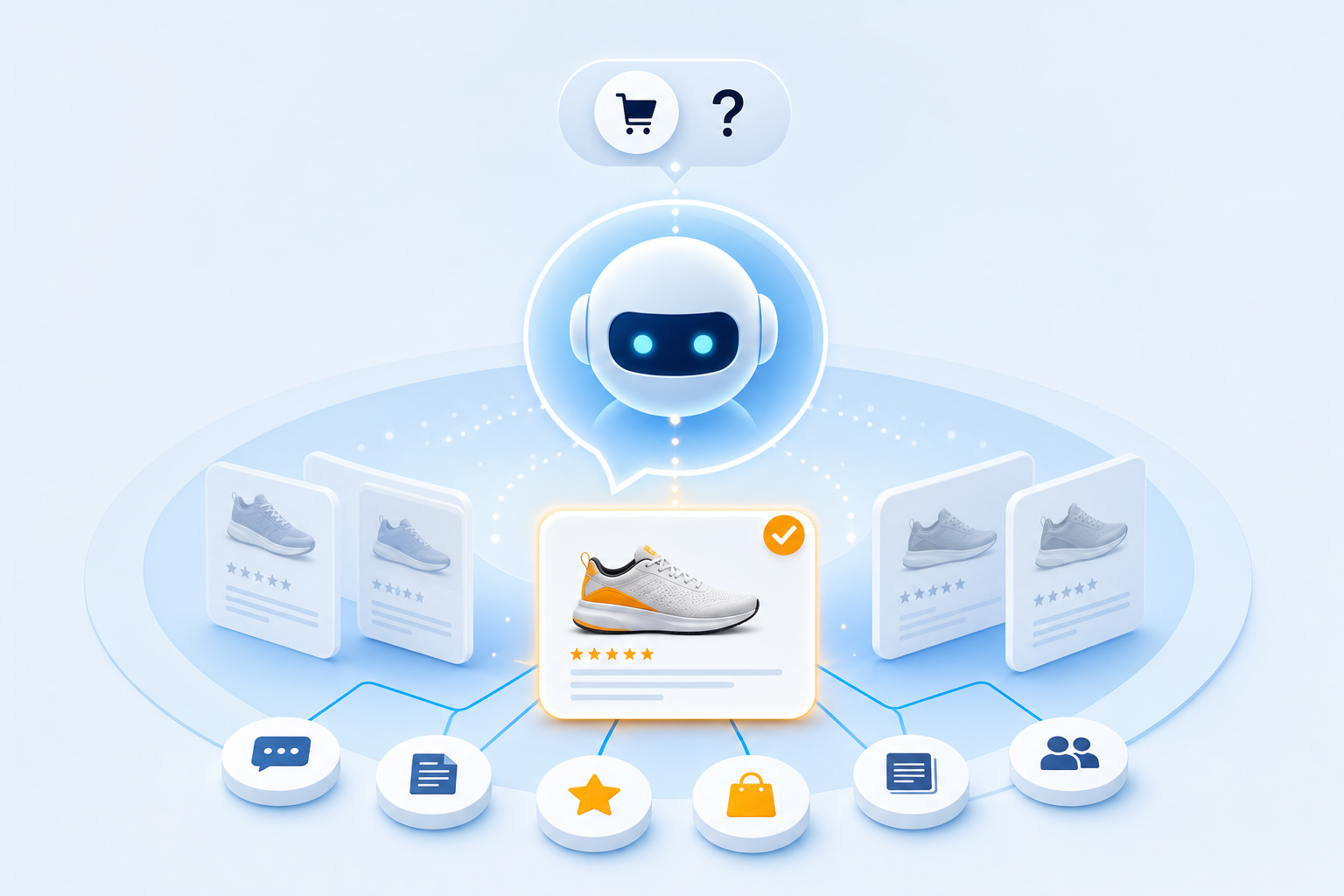
If you run a DTC brand and you're investing in SEO, you've probably noticed a new traffic source appearing in your analytics. Visitors referred by ChatGPT, Perplexity, Gemini, and Claude are arriving on your product pages with questions your static content was never written to answer. That's LLM SEO in practice: the discipline of making your brand the answer an AI assistant gives when a shopper asks a relevant question.
This guide covers what LLM SEO actually requires, how it differs from traditional search optimization, and what you need to do differently if you want AI assistants to recommend your brand consistently.
What LLM SEO Actually Means
Traditional SEO is about ranking in a list. A shopper types a query, Google returns ten blue links, and you compete for positions one through three.
LLM SEO is structurally different. AI assistants don't return a list of links. They synthesize an answer and, when they recommend a product or brand, they cite one or two sources. There is no page two. Either your brand is in the answer or it isn't.
The discipline of optimizing for that outcome is called LLM SEO, and it overlaps with terms you may have seen: Generative Engine Optimization (GEO), Answer Engine Optimization (AEO), and AI search optimization. These terms describe the same underlying problem from slightly different angles. For this guide, LLM SEO is the umbrella.
Why This Matters for Ecommerce Right Now
The scale of the shift is documented. Adobe Analytics reported that AI-driven referrals to retail sites increased roughly 1,300 percent between July 2024 and February 2025. That figure covers US retail broadly, not a narrow vertical, and it understates where the channel is heading in 2026 as AI assistants become the default starting point for product research.
Visibility Labs, analyzing 94 ecommerce brands across 12 months of GA4 data, found that AI-referred visitors show meaningfully higher engagement and lower bounce rates than organic search visitors. The interpretation is straightforward: a shopper who arrives after an AI assistant recommended your brand has already done part of the consideration work. They're further along in the decision than a typical organic visitor.
The click happened. The sale did not. That's the gap most brands are sitting in right now.
How AI Assistants Decide What to Recommend
To optimize for AI recommendations, you need to understand how LLMs select sources. The mechanics differ from Google's PageRank-based model in several important ways.
Training Data and Real-Time Retrieval
LLMs learn from large text corpora. Brands that appear frequently in authoritative, well-structured text across the web, including product reviews, editorial coverage, forum discussions, and their own published content, build what practitioners call "model weight." That's the baseline.
Most AI assistants in 2026 also have retrieval-augmented generation (RAG) capabilities, meaning they pull live content at query time to supplement what they learned in training. Perplexity is almost entirely retrieval-based. ChatGPT's browsing mode and Gemini both retrieve current content. Your published content, updated and structured correctly, can influence AI recommendations faster than traditional SEO timelines suggest.
How an AI Assistant Evaluates a Source
When an AI assistant retrieves content to answer a product question, it's looking for a few things:
- Specificity. Vague claims ("great for sensitive skin") are less useful than structured facts ("fragrance-free, pH 5.5, dermatologist-tested for rosacea-prone skin"). Specificity is what makes a source citable.
- Consistency across sources. If your product description, your FAQ, your review responses, and third-party editorial coverage all say the same thing, the LLM has stronger signal to cite you confidently.
- Completeness on comparison questions. Shoppers ask AI assistants comparison questions: "What's the difference between X and Y?" or "Is this supplement safe to take with metformin?" Content that answers those questions directly becomes a more useful source.
- Structured, crawlable content. Content locked in JavaScript renders, thin product descriptions, or image-only formats is harder for AI systems to read and index.
The LLM SEO Framework for Ecommerce Brands
Here's a practical structure for approaching this systematically.
1. Audit What AI Assistants Currently Say About Your Brand
Before you optimize, you need a baseline. Open ChatGPT, Perplexity, and Gemini. Ask each one the questions your shoppers ask: "What's the best [your category] for [specific use case]?" and "Is [your brand] good for [specific concern]?"
Document what comes back. Are you cited? Are competitors cited instead? Does the AI get your product details right, or does it misstate your formulation, return policy, sizing?
This audit tells you two things: where you're invisible, and where you're being misrepresented. Both are fixable.
Tools like Ranketta and Profound track brand visibility across AI assistants at the prompt level and can automate this monitoring at scale. They're useful for operators who want ongoing tracking rather than a manual spot-check.
2. Build Content That Answers the Questions AI Assistants Are Actually Receiving
The most common LLM SEO mistake is optimizing existing content for keywords rather than questions. AI assistants respond to natural language queries, and the questions shoppers ask them are often more specific and more nuanced than what they'd type into Google.
The question types that drive AI recommendations in ecommerce tend to follow a pattern:
- "What's the difference between [Product A] and [Product B]?"
- "Is [your product] safe for [specific condition or use case]?"
- "How long does [your product] last / take to work / hold up?"
- "What do people say about [your brand]?"
- "Can I use [your product] with [other product]?"
Your existing static pages probably don't answer these directly. A product description page optimized for "best retinol serum" doesn't answer "can I use retinol if I have eczema?" A category page doesn't answer "how does your collagen powder compare to whey protein for muscle recovery?"
Write content that does. Dedicated FAQ pages, comparison guides, use-case articles, and ingredient or material explainers all serve this function. The goal is to be the most complete, specific, and accurate source on the questions shoppers are asking before they buy.
3. Structure Your Content for Machine Readability
AI assistants parse content more reliably when it's structured clearly. Practical steps:
- Use descriptive H2 and H3 headings that match the question being answered.
- Write the answer in the first sentence under each heading, then expand. Don't bury the answer in paragraph three.
- Use schema markup: Product, FAQ, Review, and HowTo schema all help AI systems understand what your content contains.
- Keep product data consistent across your site, your Google Merchant Center feed, and any third-party listings. Inconsistency signals unreliable data.
- Make sure your key product and FAQ pages render fully in HTML, not just JavaScript. Vision-based crawlers can handle rendered pages, but many AI retrieval systems still prefer clean HTML.
4. Build Authority Signals Outside Your Own Site
AI assistants don't rely only on your owned content. They weight third-party sources heavily, because those sources represent external validation.
For ecommerce brands, the most valuable external signals are:
- Editorial coverage in publications your shoppers read. Not press releases. Actual editorial mentions where a journalist or editor evaluated your product.
- Review aggregators with structured data. Google Shopping reviews, Trustpilot, and category-specific review sites contribute to the signal an AI assistant uses to assess brand credibility.
- Community mentions in forums and social platforms that AI systems index. Reddit threads, Quora answers, and niche community discussions where your brand is mentioned accurately and positively build model weight over time.
- Consistent brand representation across all channels. Your brand name, product names, and key claims should be identical everywhere. Inconsistency creates noise that AI systems resolve by hedging or omitting you entirely.
5. Close the Gap Between the AI's Answer and Your Site
This is where most LLM SEO strategies stop, and it's where the real problem lives.
You can win the AI recommendation. A shopper sees your brand cited in ChatGPT or Perplexity, clicks through, and lands on your site. Then they ask a follow-up question, the kind they just asked the AI assistant, and your static product page has no answer. The conversation stops. So does the sale.
The AI assistant started a conversation with that shopper before they arrived. Your site needs to be able to continue it.
This is the structural gap that standard LLM SEO optimization doesn't address. Getting cited is the first half of the problem. Converting the visitor who arrives from that citation is the second half, and it requires different infrastructure.
The Two Phases of LLM SEO: Visibility and Conversion
It helps to think about LLM SEO in two distinct phases, because they require different tactics and different tools.
Phase 1: Visibility. Getting your brand cited by AI assistants. This is what most GEO and LLM SEO content covers: content strategy, schema markup, external authority signals, prompt-level tracking. Tools like Ranketta and Profound operate in this phase.
Phase 2: Conversion. What happens after the click. An AI-referred visitor arrives with higher intent than a typical organic visitor, but also with more specific expectations. They came from a conversational interface. They want to ask questions, not scroll through a static page.
Most brands have invested in Phase 1. Very few have addressed Phase 2. That's where the gap is in 2026.
If you want to understand what questions your AI-referred visitors are actually asking that your current site fails to answer, Aigency's free site scan surfaces exactly that: a brand-specific report showing the specific gaps between what AI-referred shoppers expect and what your static pages deliver. It's a useful starting point before you decide what infrastructure you need.
What Happens When AI-Referred Visitors Arrive on a Static Site
The behavior pattern is predictable. A shopper asks Perplexity "what's the best magnesium supplement for sleep?" Perplexity cites your brand. The shopper clicks through to your product page. The page shows ingredients, a price, and five-star reviews.
But the shopper wants to know: "Is this safe to take with my blood pressure medication?" or "How does this compare to glycinate?" Your product page answers neither question. The shopper bounces back to Perplexity and asks the follow-up there. Perplexity cites a competitor with a more complete FAQ.
The click happened. The sale did not.
This is why converting AI search visitors requires more than a static product page. The infrastructure that works for organic search traffic, where a shopper arrives, reads, and decides, doesn't match the behavior of a shopper who arrived mid-conversation.
Building an AI-Ready Content Architecture
A practical content architecture for LLM SEO has three layers.
Layer 1: Product data foundation. Every SKU should have complete, accurate, structured data: ingredients or materials, use cases, compatibility notes, sizing or dosing guidance, and answers to the top five questions your customer service team hears. This data needs to be consistent across your site, your feeds, and your third-party listings.
Layer 2: Comparison and consideration content. Articles, guides, and FAQ pages that answer the questions shoppers ask before they buy. Not keyword-stuffed blog posts. Specific, accurate, useful content that an AI assistant would cite because it's the best available answer to a real question.
Layer 3: Conversational infrastructure. The layer that handles AI-referred visitors after they arrive. This is where a parallel, conversational site experience becomes relevant. Rather than routing high-intent AI-referred visitors to a static page that can't continue the conversation, you give them an environment designed for the way they arrived.
Aigency builds this third layer: a parallel agentic site on your own subdomain (ai.yourbrand.com), constructed from your existing site using vision-based crawling agents with no code integration required. It's not a chatbot widget on your existing page. It's a separate, brand-owned environment designed to receive and convert visitors who arrive from AI assistants, whether those visitors are human shoppers, autonomous agents transacting on someone's behalf, or crawlers scanning your site before any human arrives. The fit with a Shopify or headless stack is worth understanding if you're evaluating what infrastructure changes this actually requires.
Common LLM SEO Mistakes to Avoid
Optimizing for keywords instead of questions. AI assistants respond to natural language. Your content should be structured around the questions shoppers actually ask, not the keywords they might have typed into Google five years ago.
Ignoring product data consistency. If your product name is spelled differently across your site, your Amazon listing, and your press coverage, AI systems have weaker signal to cite you accurately. Consistency is a trust signal.
Treating LLM SEO as a one-time project. AI assistants update their retrieval indexes regularly. Your content needs to stay current. A monitoring process that watches your main site and flags outdated AI-facing content removes the maintenance burden, but even without that, you need a process for keeping content fresh.
Stopping at visibility. Getting cited is necessary but not sufficient. If the visitor who arrives from that citation bounces because your site can't answer their follow-up questions, you've done the hard work of winning the recommendation and lost the sale anyway.
Assuming your existing chat widget is enough. A chat widget on a static page is not the same as an environment designed for AI-referred visitors. The former supplements a static experience. The latter is purpose-built infrastructure for a different kind of shopper behavior.
Measuring LLM SEO Performance
Measurement is harder than traditional SEO because AI assistants don't pass UTM parameters consistently. Here's what to track.
Referral traffic by source. Set up custom segments in GA4 for traffic from chat.openai.com, perplexity.ai, gemini.google.com, and claude.ai. These are your AI-referred visitor cohorts. Track volume, bounce rate, session depth, and conversion rate separately from organic search.
Prompt-level visibility. Tools like Ranketta and Profound track whether your brand appears in AI responses to specific queries. This tells you where you're winning and where you're invisible before the click.
Answer accuracy. Periodically query AI assistants with questions about your products and verify the answers are accurate. Inaccurate AI representations of your brand can drive high-intent visitors who arrive with wrong expectations, which creates its own conversion problems.
Content gap analysis. The questions AI-referred visitors ask that your site can't answer represent a content backlog. Tracking those gaps systematically tells you where to invest next.
The Relationship Between GEO and LLM SEO
You'll see these terms used interchangeably, and it creates confusion. Here's a useful distinction.
GEO (Generative Engine Optimization) typically refers to optimizing content so that generative AI systems cite your brand in their responses. It's focused on the pre-click phase: being in the answer.
LLM SEO is broader. It covers both the pre-click phase (visibility) and the post-click phase (conversion), and it includes the technical infrastructure required to serve AI-referred visitors effectively once they arrive.
If you're doing GEO work and not thinking about what happens after the click, you're solving half the problem. The growth of AI search traffic in ecommerce makes the post-click infrastructure increasingly important, not optional.
Where to Start
If you're new to LLM SEO, the sequence that makes sense for most DTC brands is:
- Run the manual audit. Query ChatGPT, Perplexity, and Gemini with your category's top consideration questions. Document where you appear and where you don't.
- Fix your product data foundation. Ensure every SKU has complete, accurate, structured data across all channels.
- Build comparison and FAQ content around the questions your shoppers actually ask before buying.
- Implement schema markup on product, FAQ, and review pages.
- Set up GA4 segments to track AI-referred traffic separately.
- Evaluate your post-click infrastructure. If AI-referred visitors are arriving and bouncing because your static pages can't continue the conversation, that's the next problem to solve.
The free site scan at aigency.ai is a practical way to see step six concretely: it shows you the specific questions AI-referred visitors are asking that your current site fails to answer, before you commit to any infrastructure change.
FAQs
What is LLM SEO? LLM SEO is the practice of optimizing your brand's content, product data, and site infrastructure so that large language model-based AI assistants, including ChatGPT, Perplexity, Gemini, and Claude, recommend your brand when shoppers ask relevant questions. It covers both getting cited in AI responses (visibility) and converting the visitors who arrive from those citations (post-click conversion).
How is LLM SEO different from traditional SEO? Traditional SEO targets ranked positions in a list of links. AI assistants synthesize answers and cite one or two sources, with no equivalent of page two. LLM SEO requires content structured to answer specific natural language questions, not just to rank for keyword queries. It also requires post-click infrastructure that can continue the conversation an AI assistant started before the visitor arrived.
How do AI assistants decide which brands to recommend? AI assistants weight specificity, consistency across sources, completeness on comparison and use-case questions, and structured crawlable content. Brands that appear frequently in authoritative third-party sources, maintain consistent product data across channels, and publish content that directly answers shopper questions before they buy are more likely to be cited.
What content should I create for LLM SEO? Prioritize content that answers the specific questions shoppers ask before buying: comparison guides, ingredient or material explainers, use-case FAQs, compatibility notes, and dosing or sizing guidance. The goal is to be the most complete and accurate source on the questions AI assistants receive about your category.
How do I measure whether my LLM SEO is working? Set up GA4 segments for traffic from chat.openai.com, perplexity.ai, gemini.google.com, and claude.ai. Track volume, engagement, and conversion rate for these cohorts separately from organic search. Use prompt-level tracking tools to monitor whether your brand appears in AI responses to your category's key queries.
What's the difference between GEO and LLM SEO? GEO (Generative Engine Optimization) focuses on the pre-click phase: getting your brand cited in AI-generated answers. LLM SEO is broader and includes both visibility and the post-click experience for AI-referred visitors. Most brands focus on GEO and neglect what happens after the click, which is where a significant portion of the conversion opportunity sits.
Do I need to rebuild my site to optimize for LLM SEO? No. Most LLM SEO work happens at the content and data layer: improving product descriptions, adding FAQ and comparison content, implementing schema markup, and ensuring data consistency across channels. The post-click infrastructure question is separate. Aigency builds a parallel agentic site on your own subdomain without requiring code changes to your existing store, so you don't need to rebuild anything to address the AI-referred visitor experience.
The work of LLM SEO is not complicated, but it is specific. It requires understanding how AI assistants evaluate sources, building content that answers the questions shoppers actually ask, and making sure your site can handle the visitors who arrive from those citations. Most brands have started on the visibility side. The conversion side is where the next round of work is.
https://aigency.ai/blog/llm-seo-complete-guide-ecommerce-ai-recommendations