Playbook · · 7 min read
AI Ecommerce Tools Comparison: What Separates Agents From Add-ons
By Itamar Weisbrod
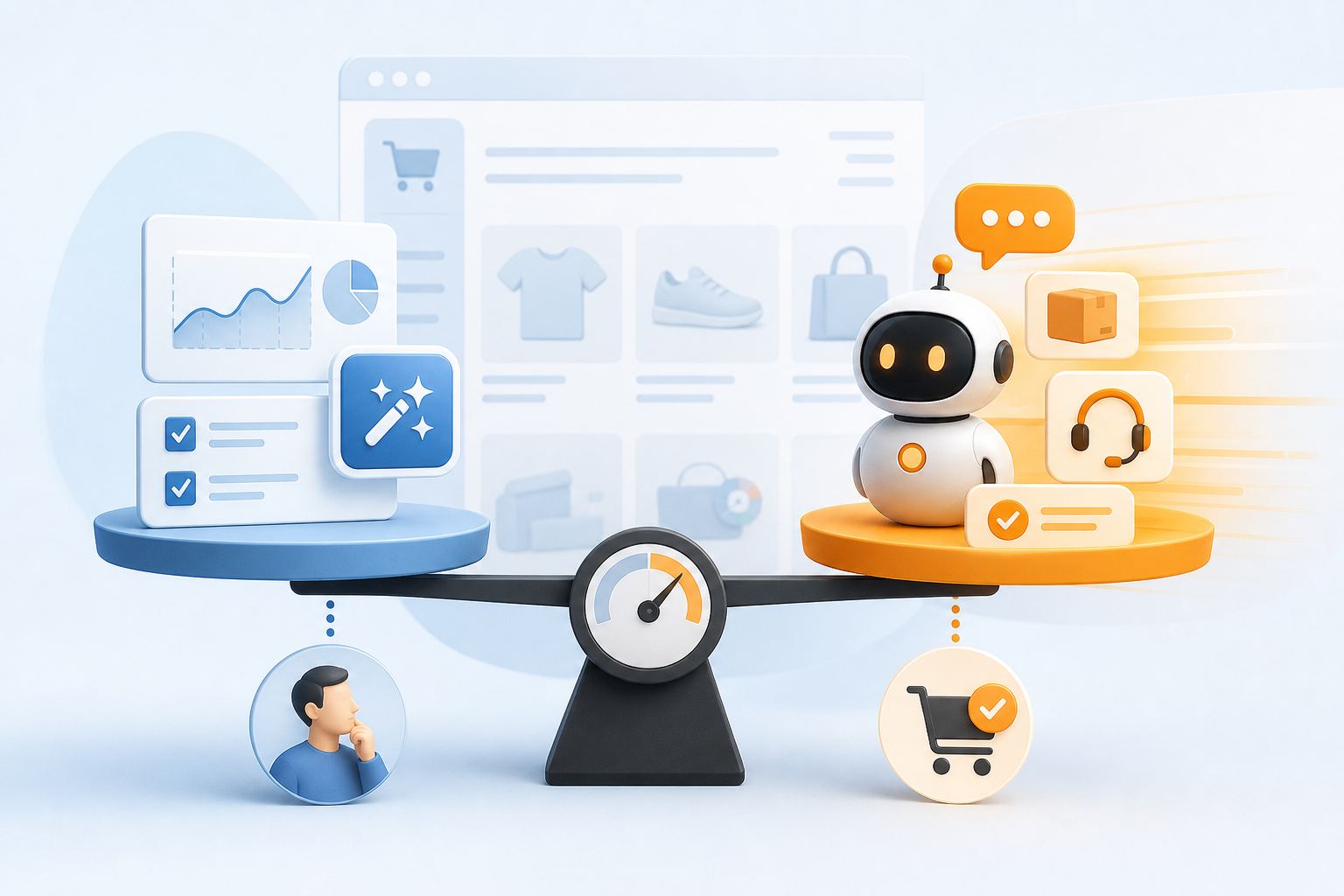
This AI ecommerce tools comparison covers two categories: add-ons that generate content or surface suggestions, and agents that execute tasks or hold conversations autonomously. Choosing the wrong type wastes budget. The right pick depends on the specific job you need done, whether that is content creation, support resolution, discovery health, or handling AI-referred traffic.
Most stores are running at least one tool in the wrong category for the job. A content generator cannot resolve a support ticket. A discovery monitor cannot hold a conversation with a shopper who arrived from ChatGPT. The distinction matters before you spend anything.
Add-ons vs. Agents: The Core Distinction in AI Ecommerce Tools
Add-ons generate outputs for a human to review and act on. Agents execute tasks or conduct conversations without waiting for a human in the loop. That single difference determines what each tool can and cannot do for your store.
According to aihackslab.com's 2026 report, 77% of ecommerce professionals use AI tools daily. That number is high, but it does not tell you whether those professionals are using tools that suggest or tools that act. Most are using both, often without a clear framework for which job each one should handle.
Add-ons are the right choice when a human needs to stay in the approval loop, such as for brand-sensitive copy or catalog changes. Agents are the right choice when speed and volume make human review impractical, such as for support resolution or real-time shopper conversations.
Best AI Ecommerce Tools Comparison: How These Four Stack Up
These four tools represent distinct points on the add-on to agent spectrum. Before reading the individual sections, use this table to orient quickly.
| Tool | Category | Primary Job | Execution or Suggestion | Store Fit |
|---|---|---|---|---|
| Beseam | Discovery monitor | Identify and rank gaps in AI product discovery | Suggestion (merchant approves changes) | Mid-market stores investing in AI search visibility |
| Nobi | Conversational search agent | Natural language product search and comparison | Execution (live shopper conversations) | Stores with large or complex catalogs |
| Shopify Sidekick | Native admin assistant | Admin tasks, content generation, data queries | Suggestion (admin-embedded) | Shopify-first merchants |
| Fin | Resolution agent | Support ticket resolution and pre-sale assistance | Execution (resolves tickets autonomously) | Mid-market to enterprise stores on Intercom |
Shopify Sidekick: Native Admin AI for Store Management Tasks
Shopify Sidekick is an admin-embedded assistant that answers data queries, edits product photos, generates descriptions, and handles store management tasks for merchants. It lives inside the Shopify admin.
The primary value here is convenience. If your team already operates Shopify as its system of record, Sidekick reduces the friction of routine tasks. You can ask it to pull sales data, draft a product description, or adjust a discount without leaving the admin panel.
Sidekick is an add-on, not an agent. It surfaces outputs for a merchant to review and act on. For Shopify-first merchants who need a capable admin assistant, it fits well.
The distinction matters because Sidekick is often the first AI tool a Shopify merchant encounters. It is a strong starting point for content and admin efficiency. It is not a substitute for tools that operate on the customer-facing side.
Beseam and Nobi: Specialized Agents for Discovery and Conversational Search
When shoppers browse through AI assistants or AI-powered site search, static product pages often fail them. Two tools address different parts of that gap.
Beseam monitors shopper signals to identify where products are missed in AI discovery, then proposes a ranked queue of store changes to fix missing product facts or weak content. The merchant approves every customer-facing change before it goes live, per beseam.com. Feature availability depends on which systems are connected to the store, so a store without integrated analytics or search data will see limited signal. Beseam is a suggestion tool with a clear workflow: it finds the gaps, you decide what to fix.
Nobi operates differently. It provides natural language site search and a conversational assistant that understands shopper intent to recommend products, compare items, and answer store policy questions. It automatically generates suggestion pills based on catalog context and shopper behavior, and it claims conversion rate increases of up to 30% or more, per docs.nobi.ai. Nobi executes in real time during a shopper session, which puts it closer to the agent end of the spectrum.
These two tools are complementary rather than competing. Beseam tells you what your catalog is missing for AI discovery. Nobi handles the live conversation once a shopper arrives. The two tools address different stages of the same problem: catalog readiness before a shopper arrives, and live conversation once they do.
Neither tool requires a platform migration. Both run in the cloud.
Fin: An End-to-End Resolution Agent That Handles Support and Pre-Sale Questions
Fin is an end-to-end resolution agent that resolves support tickets by issuing refunds and updating addresses, while also acting as a pre-sale shopping assistant. It claims to take actions across orders, payments, and fulfillment systems rather than just providing text answers.
That distinction matters. Most support tools generate a suggested reply for an agent to send. Fin executes the resolution. It requires an existing Intercom subscription, and it runs on a paid plan.
The scale claim is specific: Fin reports an average resolution rate of 76% across its 12,000 customers. That is a vendor-reported figure, not an independent benchmark, and you should evaluate it against your own ticket mix before treating it as a guarantee.
For stores where abandoned carts and unresolved pre-sale questions drive revenue loss, the case for an execution agent is direct. A tool that can answer sizing questions, confirm shipping timelines, and process a return without human intervention addresses that problem at the point where it costs money.
Fin is not a fit for stores without Intercom already in place. The dependency is real and worth accounting for in any evaluation.
How to Choose the Right AI Ecommerce Tool for Your Growth Stage
The right tool depends on your current stage, technical setup, and the specific job you need done. Enterprise adoption of AI in ecommerce functions reached 88% in 2025, but adoption alone does not indicate fit. Use this framework to narrow the field.
Start with two questions:
What is your store's stage and catalog complexity? Early-stage stores with limited catalog complexity get the most immediate value from an admin assistant like Sidekick. Mid-market stores with high support volume or large catalogs should prioritize Fin or Nobi. Stores investing in AI search visibility need Beseam in the mix.
Does your store need to be readable and actionable by AI assistants, not just human visitors? If so, check whether your current stack supports structured data and machine-readable product content. Beseam surfaces gaps here. Nobi addresses them on the front end.
For content and admin efficiency, use Shopify Sidekick. For AI discovery health, use Beseam. For on-site conversational search, use Nobi. For support resolution and pre-sale conversion, use Fin.
No single tool covers all four jobs. A store at scale likely needs two or three. The common mistake is buying an agent for a job that only needs a suggestion tool, or expecting a suggestion tool to execute autonomously.
For a broader look at how these tools compare against other options in the market, the Aigency comparison of AI tools and alternatives maps the category more fully.
When AI-Referred Shoppers Need a Different Kind of Experience
None of the four tools above was built for one specific problem: the shopper who arrives at your store after a ChatGPT or Perplexity recommendation and expects a conversational experience, not a static product page.
That visitor already has context. They were told your product might solve their problem. What they need is a page that can answer follow-up questions, compare options, and guide them to checkout in natural language. A standard PDP does not do that. Neither does a site search widget.
Aigency is an agentic commerce platform that builds a parallel, conversational version of your website on your own subdomain (ai.yourbrand.com), designed specifically to handle visitors referred by AI assistants. It crawls your existing site using vision-based agents, no code integration required, and creates a site that can hold a natural language conversation with shoppers, answer product questions, and guide them to checkout. It also scans your current site to surface the specific questions AI-referred visitors are asking that your static pages fail to answer.
The scan is free. It is a direct way to see whether your current site has a visibility problem for AI-referred traffic before committing to a solution.
For more on how AI-referred visitors behave differently from organic or paid traffic, the article on why traditional CRO fails AI-referred visitors covers the conversion mechanics in detail.
Prices and plan limits verified as of October 2026.
FAQs
Which AI tool is best for e-commerce?
No single tool is best across all use cases. Shopify Sidekick fits merchants who need admin and content help inside the Shopify platform. Fin fits stores with high support volume that need autonomous ticket resolution. Beseam and Nobi fit stores focused on AI discovery and conversational search. The right choice depends on the specific job: content creation, support resolution, discovery health, or handling AI-referred traffic.
What is the difference between AI agents and AI copilots in ecommerce?
A copilot or add-on generates a suggestion that a human reviews and acts on. An agent executes the task directly, whether that means resolving a support ticket, updating an order, or holding a live conversation with a shopper. The practical difference is speed and scale: agents handle volume that would require a human team to match, while copilots keep a human in the loop for quality control.
Do AI ecommerce tools work for small stores or only enterprise?
Most tools in this comparison work at multiple store sizes, but the value scales with volume. A small store with low support ticket counts will see limited return from a resolution agent like Fin. Shopify Sidekick is accessible to any Shopify merchant. Beseam and Nobi are more relevant once a store has enough catalog depth and traffic to generate meaningful signals. Enterprise adoption is high, but small stores can start with lower-commitment tools and add execution agents as volume grows.
How do AI ecommerce tools affect abandoned cart rates?
Tools that resolve pre-sale questions in real time, such as Fin acting as a shopping assistant, address one of the main reasons shoppers abandon carts: unanswered questions about fit, shipping, or returns. A conversational agent that answers those questions before checkout removes a friction point that static pages cannot address.
What technical setup is required to use most AI ecommerce agents?
Requirements vary by tool. Shopify Sidekick requires only a Shopify account. Fin requires an existing Intercom subscription. Beseam's feature availability depends on which search and analytics systems are connected to your store. Nobi runs in the cloud and does not require a platform migration. Aigency requires no code integration: it crawls your existing site using vision-based agents to build the agentic subdomain.
Conclusion
The add-on versus agent distinction is the most useful filter when evaluating AI ecommerce tools. Add-ons handle content creation and admin tasks well. Agents handle execution at scale, whether that is support resolution, live shopper conversations, or discovery gap analysis. Most stores need at least one of each, matched to the right job.
Start by identifying the highest-cost gap in your current setup. If support volume is the problem, evaluate Fin. If AI search visibility is the gap, look at Beseam. If you have AI-referred traffic arriving at static pages, run the free scan to see what those visitors are actually asking that your static pages fail to answer. That data tells you what to fix before you commit to a solution.