Playbook · · 11 min read
ChatGPT Product Discovery: Get Your Store Recommended
By Itamar Weisbrod
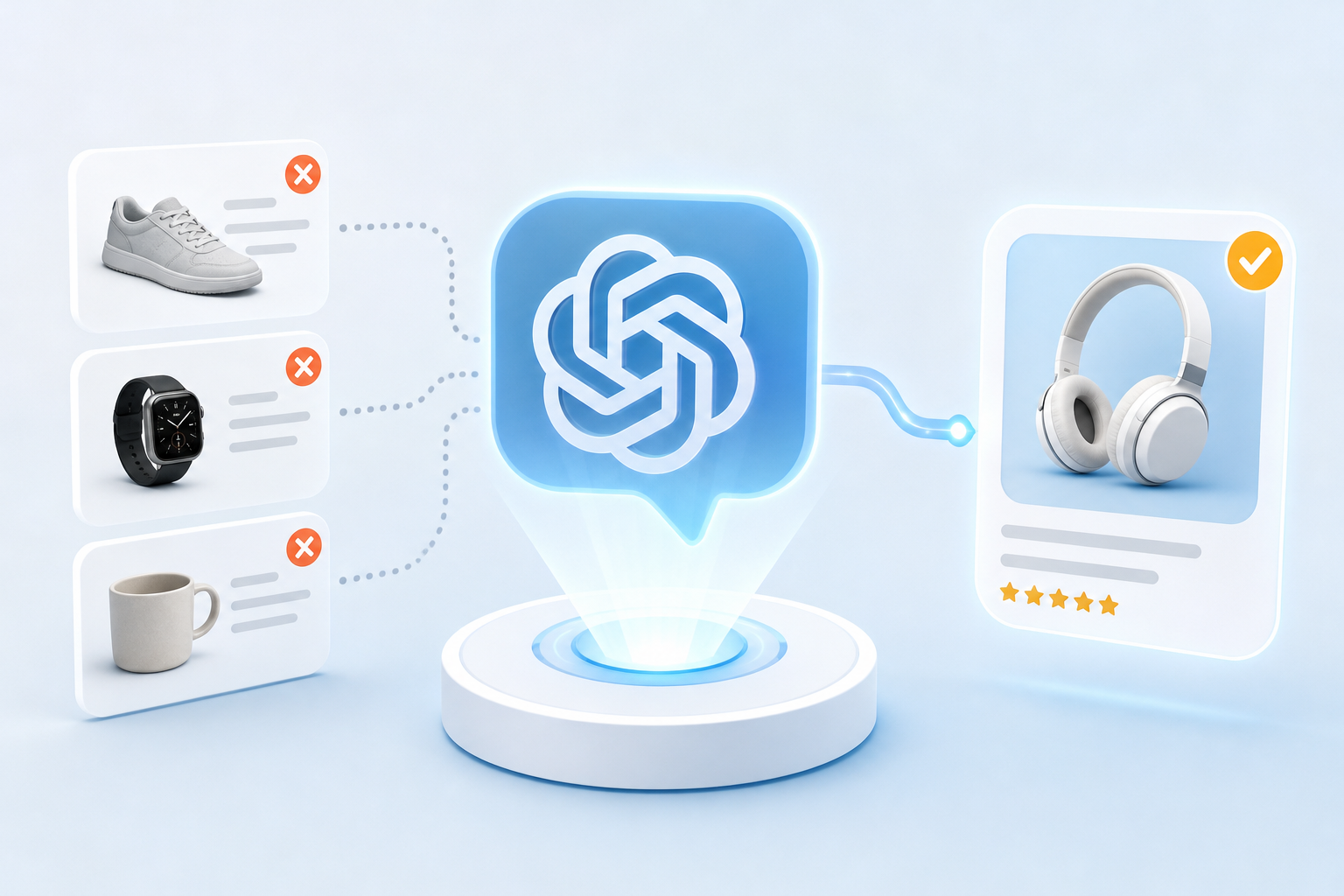
Product discovery in ChatGPT starts with a few concrete steps: allow OAI-SearchBot in robots.txt, publish complete schema.org Product data, submit a fresh product feed through the Agentic Commerce Protocol (Shopify merchants can use Shopify Catalog), keep price and availability accurate, and earn independent reviews. Placement is organic, and a top Google rank does not guarantee a mention. This guide covers the work in order, from crawler access to measurement.
How does product discovery in ChatGPT work?
ChatGPT builds product recommendations from three pipelines, and you can influence all three. This is the discovery layer of agentic commerce. Before an agent can compare products, answer questions, or help a shopper decide, a model has to choose which products it has read about, trusts, and can cite.
The scale of that layer is no longer small. A Forrester survey of US online adults in February 2026 found that 26% had used ChatGPT for product research within the previous month. Naridon reported that AI search accounted for 14.7% of all e-commerce discovery traffic by early 2026.
Here are the three pipelines:
- Crawling.
OAI-SearchBotindexes your pages for ChatGPT search. Per OpenAI's bot documentation, sites that opt out of it are not shown in ChatGPT search answers. - Merchant feeds. The Agentic Commerce Protocol (ACP) is an open standard that connects merchant product feeds to AI agents for discovery and reasoning. It is built for AI reasoning rather than simple keyword indexing, and it supports real-time updates every 15 minutes.
- Third-party corroboration. Reviews, editorial roundups, and community threads give the model independent evidence. Products that appear in both your feed and outside coverage do better than either alone.
OpenAI runs separate crawlers for separate jobs. OAI-SearchBot determines search visibility. GPTBot collects training data, and blocking it does not remove you from search. ChatGPT-User fetches a page live when a user or agent asks for it. The setup details come in the technical section below.
On the shopper side, ChatGPT Shopping uses conversational AI to produce curated recommendations, visual carousels, and side-by-side comparisons. Product selection there is interpretive, so some brands get left out, and the prices shown can lag behind live store data. Both are reasons to keep your own data accurate and fresh.
Why did ChatGPT shift from Instant Checkout to discovery-first commerce?
OpenAI moved from selling inside the chat to deciding which products shoppers see, and left the purchase to merchants. On September 29, 2025, OpenAI and Stripe launched Instant Checkout: US ChatGPT users could buy from US Etsy sellers without leaving the conversation, with over a million Shopify merchants announced as coming.
In March 2026, OpenAI changed course. The first version of Instant Checkout lacked the flexibility it wanted, so merchants can now use their own checkout while OpenAI concentrates on product discovery. Large retailers integrated ACP for discovery, and Shopify's Catalog now syndicates merchant data into ChatGPT automatically.
The audience justifies the focus. ChatGPT draws a very large weekly user base (TechCrunch, October 2025), and many of those people ask a model what to buy.
This is not a checkout problem. It is a selection problem. However checkout settles, the model still picks which products to put in front of a shopper, and the shopper makes the final call.
So do not plan around in-chat purchase. Your checkout, your payment flow, and your customer relationship stay yours. What you need is a place on the shortlist, and that depends on how readable, accurate, and corroborated your product data is.
Does ranking #1 on Google guarantee a ChatGPT recommendation?
No, ranking #1 on Google does not guarantee a ChatGPT recommendation: ranking well on Google does not carry over into ChatGPT answers, and the gap is wider than most operators assume. PageTraffic's September 2026 research found that 50% of websites ranking on the first page of Google were not mentioned in the corresponding AI shopping responses. A separate PageTraffic visibility gap study found that Google's top-ranked organic result was absent from all AI shopping answers 21% of the time.
Here is what actually happens. A ranked list of links rewards pages that match a query and collect authority signals. A conversational answer picks a handful of products and explains why. The model weighs whether it can read your data, whether other sources back it up, and whether price and availability hold up. A page can win on the first and fail the rest.
ChatGPT does not always show products at all. In a 2026 AEOsome visibility study, ChatGPT displayed a product card for 28.5% of shopping queries. For the rest, shoppers got text answers, and the brands named there depend on what the model has read and trusted.
The contrast with Google Search is structural:
- Google returns a list. You compete for a position, and the shopper chooses.
- ChatGPT returns an answer. You compete for inclusion, and the model filters first.
That filter is why ChatGPT Shopping behaves differently from search. The model's selection is interpretive, so a brand with strong Google rankings but thin, unstructured product pages can vanish from the answer entirely.
Keep your SEO work. It still feeds discovery. But treat ChatGPT visibility as its own target with its own checks, starting with whether the model can read your store at all.
What technical setup does ChatGPT need to read your store?
ChatGPT can only recommend what it can fetch and parse, so crawler access and structured data come before anything else. Work through these in order.
- Enable AI crawler access in robots.txt. Allow
OAI-SearchBotexplicitly. Then decide on the other two OpenAI agents separately, using the table below. The OpenAI bot documentation lists the user-agent strings to match. - Publish schema.org Product markup. Include price, availability, ratings, and a clean canonical URL on every product page.
- Server-render the content. JavaScript-only storefronts are the common failure: the crawler fetches a shell and finds no product. An agent-readable storefront fixes this at the root.
- Verify the hits. Check your server logs for
OAI-SearchBotrequests. Logs show what the crawler actually reached, which analytics cannot.
| Crawler | Job | Your call |
|---|---|---|
OAI-SearchBot |
Indexes pages for ChatGPT search answers | Allow it. Blocking it removes you from ChatGPT search. |
GPTBot |
Collects training data | Your choice. Blocking it does not affect search visibility. |
ChatGPT-User |
Fetches a page live for a user or agent | Allow it if you want agents opening your pages. |
For a closer look at the user agents, see ChatGPT's shopping user agents.
Structured data quality is where most stores fall short. A benchmark report from Naridon found that only 23% of Shopify stores maintain the structured data quality AI engines require in 2026. Clear this step and you are ahead of most of your category.
Ranking logic follows from what the model can verify. Where several merchants sell the same item, relevance, price, availability, and quality signals decide who gets shown. None of that gets scored if the page is unreadable.
How do you submit a product feed and use Shopify Catalog?
A feed gives ChatGPT your catalog in a form built for AI reasoning, so it does not have to infer products from page markup alone. The ACP standard was designed for this rather than keyword indexing.
Follow these steps:
- Complete every product record. Each product needs
item_id, price, availability, image, and category. Products without categories or images are excluded. - Submit the feed. The feed spec accepts Google Shopping-compatible files, so you rarely start from zero.
- Refresh it daily. Synchronize price and inventory so the feed matches the page. A mismatch between the two is the fastest route out of a recommendation set. ACP supports updates as often as every 15 minutes.
- Add review and rating data. Reviews and ratings strengthen recommendation rankings.
- Check eligibility. The
is_eligible_searchflag controls whether a product can surface in ChatGPT search at all. A feed can exist and still opt products out.
Shopify merchants have a shorter path. Shopify Catalog syncs product data with AI platforms automatically, so you skip manual feed maintenance. Turn on the ChatGPT channel in the Shopify Agentic settings, then confirm every product carries a price, image, and category.
Two limits apply. Initial eligibility requires that you sell to US customers. And Catalog only syndicates what your catalog contains, so thin product data travels thin.
If you run on another platform, you do the plumbing by hand: build the feed, schedule the refresh, and monitor errors. The protocol is open, so you do not need Shopify to participate.
This is how product discovery works across OpenAI's surfaces. Whether a shopper uses ChatGPT itself or a merchant app built on the same commerce standards, the product data you submit is the common input.
What is Generative Engine Optimization (GEO) for product pages?
Generative Engine Optimization (GEO) is a term for the work of getting your products named in AI assistant answers. The goal changes from earning a position to earning a mention. The inputs overlap with SEO, but the checks differ.
For product pages, GEO comes down to a short set of practices:
- Specific page copy. State materials, dimensions, use cases, and comparisons. Write the sentence you want the model to quote.
- Reviews and ratings. Structured review data gives the model evidence it can verify.
- Independent mentions. Category roundups, retail reviews, and authentic forum presence corroborate your claims.
- Accurate price and stock. Stale data gets products dropped.
Frequency varies, and how often a product card appears depends on the query type and how the system routes the request between models. Treat any single visibility number as a snapshot, not a promise.
The size of the prize is worth tracking. Naridon put AI search at 14.7% of e-commerce discovery traffic by early 2026. Brands that optimize for both surfaces are competing in a field where many rivals have not started.
GEO covers the part before the click. What happens after it is a separate problem. Aigency is an agentic storefront platform that builds an agentic version of your site on your own subdomain (ai.yourbrand.com), made for visitors referred by AI assistants like ChatGPT and Perplexity. It crawls your existing site with vision-based agents, needs no code integration, talks with shoppers in natural language, and surfaces the questions AI-referred visitors ask that your static pages fail to answer.
It handles both the humans who arrive from an AI shopping agent and the crawlers that scan your site first. The scan is free, and it is a practical way to see which questions your current pages miss.
How do you know if ChatGPT is sending you traffic?
You know ChatGPT is sending you traffic when sessions arrive tagged with utm_source=chatgpt.com, which OpenAI appends to links users click out of ChatGPT. In GA4, build a custom channel group or exploration that matches session sources containing chatgpt, then read it in the Traffic Acquisition reports.
Expect undercounting. Some visits arrive with stripped referrers and land in Direct or Unassigned. Pages fetched by ChatGPT-User on a shopper's behalf never fire client-side analytics at all. Server logs are the ground truth: crawler hits show the machines are reading you before referral traffic appears.
Benchmark quality, not just volume. Adobe Analytics has tracked AI referrals to US retail sites growing quickly (Adobe Analytics, March 2025), and has reported revenue per visit 37% higher for AI-referred visits than for non-AI traffic. Adobe Analytics via Digital Commerce 360, June 2026 tracks the channel's continued growth. For the wider picture, see our guide on how to rank in ChatGPT for ecommerce and the AI traffic sources comparison.
Review these five checks monthly:
- Crawler hits from OAI-SearchBot appear in your logs.
- ChatGPT-referred sessions are growing in GA4.
- Those sessions convert at or above your site average.
- Feed price and availability match the live page.
- Your products still appear when you test your core shopping queries.
Prices and plan limits verified as of November 2026.
FAQs
Does ranking #1 on Google guarantee a recommendation in ChatGPT?
No. PageTraffic's September 2026 research found that many websites on the first page of Google were not mentioned in corresponding AI shopping responses. Its separate visibility gap study found Google's top organic result was absent from all AI shopping answers 21% of the time. Treat ChatGPT visibility as its own target, with its own checks on crawler access, structured data, and independent mentions.
Can I pay to appear in ChatGPT's product recommendations?
No. Product results in ChatGPT are organic and ranked on relevance, not payment. OpenAI shows clearly labeled ads to free-tier users, but those are separate from answers. Shopping recommendations themselves are not a paid placement, so your levers are data quality, crawler access, and earned third-party coverage.
Should I block GPTBot from my store?
Know the difference first. GPTBot only collects training data, and blocking it does not remove you from ChatGPT search. OAI-SearchBot controls whether you appear in search answers, and ChatGPT-User fetches pages live for a user. If you want AI traffic, blocking OAI-SearchBot is self-inflicted invisibility. GPTBot is a separate policy decision.
Do I need to be on Shopify or Etsy to appear in ChatGPT shopping?
No. Any merchant can allow OpenAI's crawlers and submit a product feed through the Agentic Commerce Protocol, which accepts Google Shopping-compatible files. Shopify's Catalog automates the syndication for its merchants, so other platforms do that work by hand: build the feed, schedule the refresh, and monitor errors.
How does ChatGPT Shopping differ from traditional Google Search?
Google returns a ranked list of links, and the shopper chooses. ChatGPT Shopping returns a conversational answer with curated recommendations, carousels, and comparisons. The model filters first, so you compete for inclusion rather than position.
What is the Agentic Commerce Protocol?
The Agentic Commerce Protocol (ACP) is an open standard that connects merchant product feeds to AI agents for discovery and reasoning. It is designed for AI reasoning rather than keyword indexing and supports updates as often as every 15 minutes. Merchants use it to submit structured product data that ChatGPT can read, compare, and cite.
Conclusion
Product discovery in ChatGPT depends on four things you control: crawler access, structured product data, a fresh feed, and independent mentions. A top Google ranking does not substitute for any of them, and placement cannot be bought.
Start by checking robots.txt for OAI-SearchBot and confirming your product pages render server-side with schema.org markup. Then tag ChatGPT referrals in GA4 so you can see whether the traffic converts, and recheck your core shopping queries each month to confirm your products still appear.