Playbook · · 8 min read
Ecommerce Agent: What It Is and Why Your Store Needs One
By Itamar Weisbrod
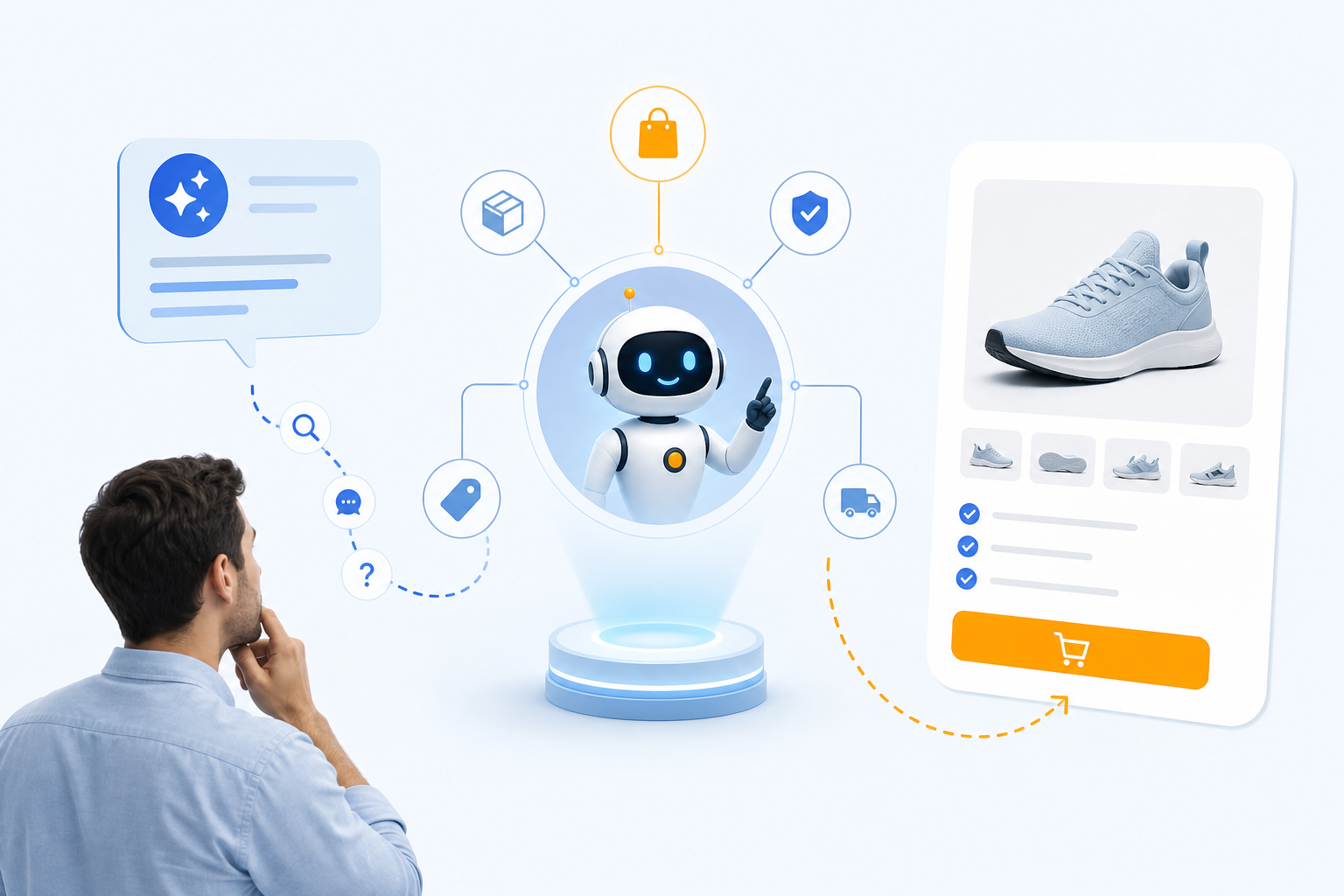
Adobe Analytics reported that AI-driven referrals to retail sites grew over 800 percent year on year. That number is already in your traffic data, sitting inside a referral source most GA4 dashboards label as "direct" or fold into unattributed sessions. An ecommerce agent is the infrastructure built to receive that traffic and do something useful with it. This article explains what an ecommerce agent actually is, how it differs from the tools most DTC operators already have, and when your store genuinely needs one.
What an Ecommerce Agent Actually Is
The term gets used loosely, so precision matters here.
An ecommerce agent is a software system that holds a goal-directed conversation with a shopper, accesses your product catalog and policies, and guides that shopper toward a purchase decision without requiring human intervention at each step. It does not answer a question and stop. It holds context across the conversation, asks clarifying questions when needed, and adapts based on what the shopper has already said.
That is meaningfully different from a live chat widget or a scripted FAQ bot. Those tools respond to inputs. An ecommerce agent pursues an outcome.
The distinction matters because shoppers arriving from ChatGPT, Gemini, Perplexity, and Claude are not arriving cold. They have already had a conversation with an AI assistant. They asked something like "what's the best collagen supplement for someone over 40 who doesn't want to take capsules" and your brand came up in the response. By the time they click through, they have a specific question in mind. Your static product page does not know what that question is. It cannot continue the conversation. The click happened. The sale did not.
An ecommerce agent picks up where the AI assistant left off.
The Gap Static Pages Cannot Close
Most product pages were designed for a different traffic pattern. The visitor arrives from a search result, scans the page, and either converts or leaves. The page does not need to know anything about prior context because search traffic rarely carries any.
AI-referred traffic carries a lot of it. These shoppers have already been through a research conversation. They are not at the top of the funnel. They are at the bottom, with a specific question your PDP almost certainly does not answer directly.
This is not a content problem. It is an architecture problem.
You could add more copy to your PDPs, write longer FAQ sections, build out comparison tables. Some of that helps with GEO visibility, and if you have not read the complete guide to LLM SEO for ecommerce AI recommendations, it is a useful starting point for that work. But no amount of static content can respond to a question it has not seen before. A shopper asking "does this moisturizer work well under SPF 50 if I have rosacea and live in a humid climate" is not going to find that answer in a bullet list.
An ecommerce agent can answer that question. It can ask a follow-up. It can surface the right product variant. It can explain your return policy if the shopper hesitates. It operates like a knowledgeable sales associate, not a brochure.
How an Ecommerce Agent Differs from a Chatbot
The word "chatbot" is doing a lot of work right now, and most of it is imprecise.
A chatbot is typically a widget embedded on a page. It responds to typed inputs within a defined decision tree or, in more recent implementations, uses a language model to generate responses. It lives on your existing site. It does not change the page the shopper is looking at. It does not have a structured view of your catalog, your policies, or your brand voice unless someone has manually configured it.
An ecommerce agent, in the complete sense, is a purpose-built environment. It has access to your product data. It understands your brand's tone and guardrails. It is designed to handle the full arc of a pre-purchase conversation, not just respond to a single query.
The architectural difference is significant. A widget on a static page is still a static page with a widget. A dedicated agent environment is built from the ground up to handle conversational commerce. The shopper's experience is fundamentally different because the surface they are interacting with is fundamentally different.
This is part of why the agentic commerce discussion is worth reading carefully. The category is moving fast and the terminology is not yet standardized. What a vendor calls an "agent" today may be a chatbot with better marketing copy.
What an Ecommerce Agent Needs to Work Well
Not every store needs an ecommerce agent today. The ones that do share a few characteristics.
High-consideration products. If your customers routinely ask comparison or fit questions before buying, a static page is losing them at the moment they are most ready to purchase. Skincare, supplements, apparel, home goods, and similar categories all follow this pattern. If your average order value is above $60 and your product has more than two or three meaningful variables (size, formulation, use case, compatibility), you are in the right category.
Growing AI referral traffic. If you are tracking referral sources and seeing sessions from ChatGPT, Perplexity, or similar, those visitors are already there. The question is whether your site is equipped to handle them. If you are not tracking this yet, that is the first thing to fix.
A conversion rate that has not kept pace with traffic growth. Traffic is up. Revenue is not moving proportionally. That gap has multiple causes, but for stores in the categories above, AI-referred traffic bouncing on static pages is increasingly a contributor.
A small team. An ecommerce agent that requires ongoing manual maintenance, developer involvement, or a dedicated content team to stay current is not practical for a team of two to fifteen people. The operational overhead has to match the team's capacity.
How Aigency Builds an Ecommerce Agent for Your Store
Aigency takes a specific approach that is worth understanding because it differs from how most tools in this category work.
Rather than installing a widget on your existing site or requiring a platform integration, Aigency builds a parallel agent site hosted on your own subdomain at ai.yourbrand.com. That site is created using vision-based crawling agents that read your existing site the way a human visitor would. No code integration. No database access. No developer involvement.
Once the agent site is live, it holds natural language conversations with shoppers, answers product questions, and guides visitors toward checkout. It is not a layer on top of your existing pages. It is a separate, purpose-built environment designed for the conversational traffic pattern that AI assistants generate. It serves AI-referred human shoppers, autonomous agents transacting on a user's behalf, and crawlers scanning your catalog before any human arrives.
Three named agents handle ongoing operations. The Style Agent extracts your visual identity so the parallel site stays on-brand without manual design work. The Monitoring Agent watches your main site and updates the agent site automatically when your content changes, removing the maintenance burden that makes most tools impractical for small teams. The Policy and Control Agent lets you define exactly what the agent can say, what it must never say, and where it directs users, giving you explicit guardrails over agent behavior.
The platform also supports visual search. Shoppers can upload a photo to search your product catalog by image, which matters for apparel and home goods categories where shoppers often know what they want but cannot name it.
Because the agent site lives on your own subdomain, you retain full domain ownership. The experience is not hosted on a third-party domain. Your brand stays yours.
If you want to understand how this fits alongside your existing Shopify or headless setup, the integration overview covers the specifics without requiring a technical background to follow.
The Free Scan: Understanding Your Specific Gap
The most useful starting point, before committing to any ecommerce agent infrastructure, is understanding what questions your AI-referred visitors are actually asking that your current pages do not answer.
Aigency offers a free site scan that does exactly this. It crawls your existing site and surfaces the specific questions AI-referred visitors are asking that your static pages fail to address. The output is a gap analysis specific to your store, not a generic audit template.
This is worth doing regardless of what you decide next. Knowing which questions your AI-referred traffic is asking is useful for your GEO content strategy, your PDP copy, your FAQ structure, and your paid search targeting. The scan produces a real, personalized output before any purchase commitment.
You can start that scan at aigency.ai.
Why This Is Happening Now
The growth in AI-referred traffic is not a niche phenomenon. Adobe Analytics data shows it accelerated sharply through 2025 and into 2026 across US retail. The behavior driving it is straightforward: consumers are using AI assistants as research tools before they buy. The assistant recommends a product or a brand. The consumer clicks through. They arrive at a site that was not built to receive them.
The stores that continue that conversation, rather than dropping the shopper into a static page and hoping for the best, are the ones that will capture the conversion rate improvement the traffic growth should already be generating.
This is not a prediction about where ecommerce is heading. It is a description of what is already happening in your traffic data. The question is whether your store is set up to act on it.
For a deeper look at where consumer shopping agents are heading, the analysis of Meta Muse and consumer shopping agents is worth reading alongside this piece.
Frequently Asked Questions
What is an ecommerce agent? An ecommerce agent is a software system that holds goal-directed conversations with shoppers, accesses your product catalog and policies, and guides visitors toward a purchase without human intervention at each step. It differs from a chatbot in that it pursues an outcome across a full conversation rather than responding to individual inputs in isolation.
How is an ecommerce agent different from a chatbot widget? A chatbot widget sits on top of an existing static page and responds to typed inputs. An ecommerce agent is a purpose-built environment designed for conversational commerce. It has structured access to your product data, understands your brand's tone and guardrails, and handles the full arc of a pre-purchase conversation, not just a single query.
Which stores actually need an ecommerce agent right now? Stores selling high-consideration products where shoppers ask comparison or fit questions before buying, stores already seeing AI referral traffic from ChatGPT, Perplexity, Gemini, or Claude, and stores where conversion rates have not kept pace with traffic growth are the most immediate candidates. Low-consideration, commodity products with simple purchase decisions are less likely to see a material difference.
Does setting up an ecommerce agent require developer work? It depends on the approach. Aigency's vision-based crawling model requires no code integration, no database access, and no developer involvement. The parallel agent site is built automatically by reading your existing site the way a human visitor would. Other approaches in the category typically require platform integration or custom development work.
What is AI-referred traffic and how do I track it? AI-referred traffic is sessions that originate from AI assistants like ChatGPT, Perplexity, Gemini, or Claude, where the assistant recommended your brand or product and the user clicked through. In GA4, this traffic often appears as direct or unattributed. Tracking it accurately requires UTM parameters on any links the assistant generates, or referral source filtering for known AI assistant domains.
What does the free Aigency site scan actually produce? The scan crawls your existing site and surfaces the specific questions AI-referred visitors are asking that your current static pages do not answer. The output is a gap analysis specific to your store. It is an entry point for understanding your AI traffic problem, not a product signup.
How does an ecommerce agent stay current when my product catalog changes? Aigency's Monitoring Agent watches your main site and automatically updates the parallel agent site when your content changes. This removes the ongoing maintenance burden that makes most tools impractical for small teams. You do not need to manually sync the agent site when you add products, change pricing, or update policies.
The Practical Priority Right Now
The practical priority is not building a full agentic commerce strategy before you understand your specific gap. It is finding out what questions your AI-referred visitors are already asking that your site cannot answer.
Start with the free scan at aigency.ai. The output will tell you more about your actual exposure than any general framework can.
https://aigency.ai/blog/ecommerce-agent-what-it-is-why-your-store-needs-one