Perspective · · 4 min read
Meta Muse and the Inflection Point for Consumer Shopping Agents: Why Ecommerce Leaders Need Agent-Accessible Stores Now
By Itamar Weisbrod
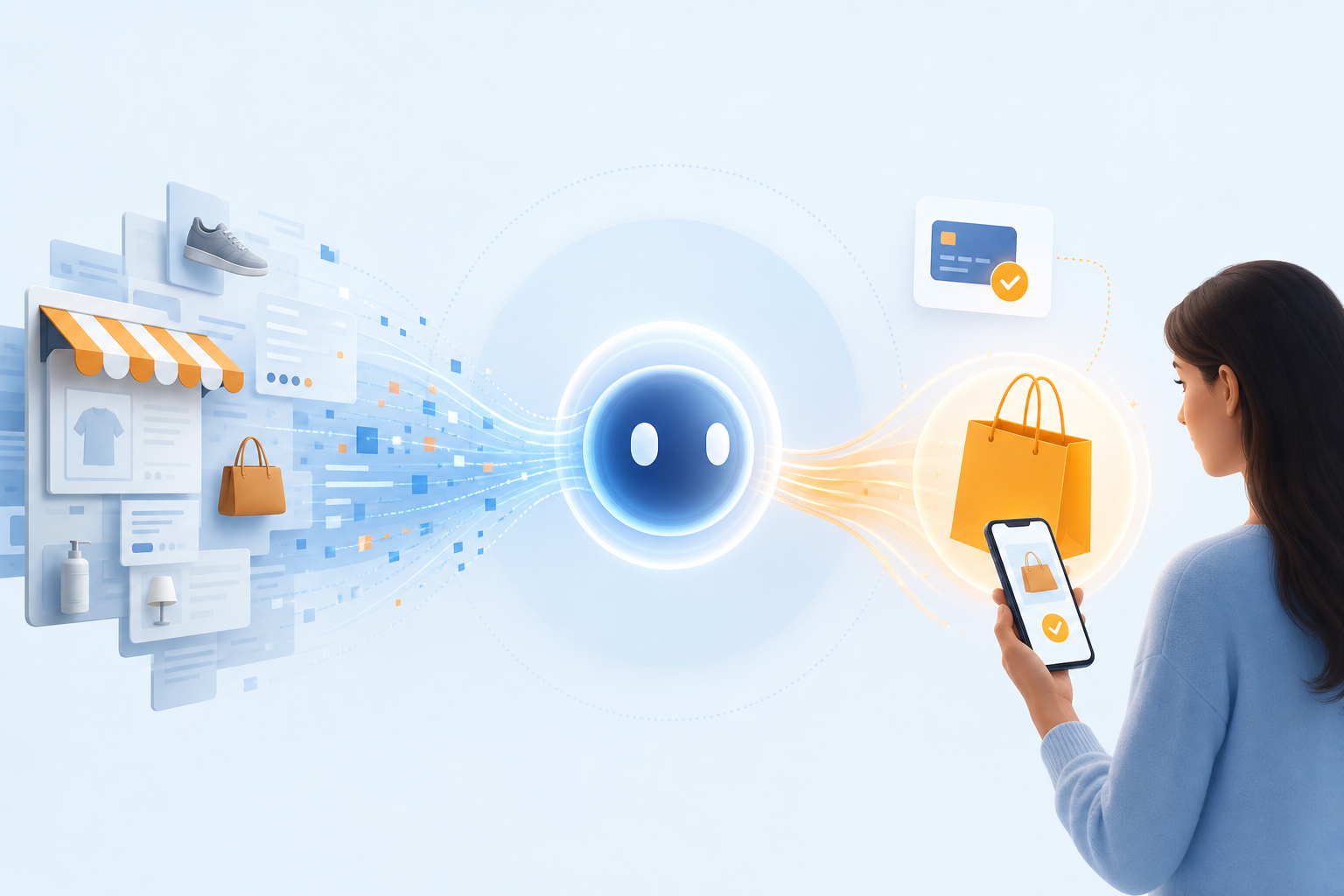
Meta launched Muse on September 8, 2026, and the consumer AI agent ecommerce story shifted. Not because the technology is new. Because the distribution is.
Muse is a personal AI agent app. It connects to your email, calendar, payments, shopping, health, smart home, dining, music, and events apps to handle everyday tasks on your behalf. Free tier, with paid plans at $20 and $100 per month, as covered by TechCrunch and CNBC. It launched days after Meta settled an $18 billion multistate lawsuit -- meaning the company is asking 3.5 billion existing users to hand a new product access to their payments and personal data.
That context matters. This is not a frontier lab shipping a research preview to 50,000 power users. This is a mainstream consumer platform pushing agent-assisted shopping into the same interface where people already scroll, message, and buy.
Why This Reads as an Inflection Point
ChatGPT shopping referrals have been real and growing. Adobe Analytics reported AI-driven referrals to retail sites grew roughly 1,300% between July 2024 and February 2025. But that traffic came from a self-selected group: people who actively chose to use an AI assistant for research.
Muse changes the population. When an agent is pre-installed, connected to your payment methods, and framed as a general life assistant for billions of existing users, agent-assisted shopping stops being a niche behavior. It becomes a default path for a much larger, far less technically self-selected group of shoppers.
The short answer is: consumer shopping agents are going mainstream because Meta is distributing one to its existing base -- not because the underlying technology crossed some new threshold.
What This Means for Your Store
Here is what actually happens when a shopping agent acts on a shopper's behalf. It does not open a browser, scroll your product page, and read your copy the way a human does. It queries structured data, calls APIs, reads machine-readable content, and looks for clear signals about inventory, pricing, and purchase paths.
If your store is not accessible in that way, the agent does not struggle with it. It moves on.
This is not a conversion optimization problem. It is a visibility problem. A store an agent cannot read is effectively invisible to that agent -- regardless of how well it performs for human visitors or how strong its SEO is.
The practical priority right now is not building a Muse-specific integration. It is making sure your store is agent-accessible at all, and that you have a control plane governing what agents can see and do when they arrive.
That means three things:
- Observability. Know when an agent or AI-referred shopper is on your site, what they are asking, and where your current pages fail to answer them.
- Policy. Define what agents are permitted to do -- query inventory, initiate checkout, apply discounts, surface alternatives. Without explicit policy, you have no governance.
- Transaction rails. The handoff from agent query to actual purchase needs a clear path. Static pages with no conversational layer are not that path.
This is the framing behind what Aigency builds: a connective layer between AI agents and your transactional website, serving both AI-referred human shoppers and autonomous agents acting on a shopper's behalf. Not an agent-only surface. Not a replacement for your existing store.
The Window Is Short
Muse will not be the last mainstream consumer agent. Gemini, Copilot, and others are building toward the same surface. The question is not whether agent-assisted shopping will be a meaningful channel. It already is for some operators, and it is about to be for many more.
The stores that are agent-accessible when that traffic arrives will capture it. The ones that are not will be invisible to it.
Start by understanding what agents can currently see and do on your site. The free Link Visibility scan at aigency.ai is a reasonable first step.
FAQs
What is Meta Muse?
Meta Muse is a personal AI agent app launched by Meta on September 8, 2026. It connects to a user's email, calendar, payments, shopping, and other apps to complete everyday tasks -- including shopping -- on their behalf. It offers a free tier and paid plans at $20 and $100 per month.
Why does Meta Muse matter for ecommerce specifically?
Meta is distributing an agent-assisted shopping interface to its existing base of 3.5 billion users. That shifts agent-assisted shopping from a niche early-adopter behavior to a mainstream consumer pattern at scale.
What does "agent-accessible" mean for an ecommerce store?
It means an AI agent can read your product data, understand your inventory and pricing, and initiate or complete a purchase transaction without hitting a dead end. Stores that are not agent-accessible are effectively invisible to agents acting on a shopper's behalf.
Does making my store agent-accessible require a full replatform?
Not necessarily. The priority is adding a layer that handles agent queries and provides clear transaction rails -- without replacing your existing Shopify, BigCommerce, or other commerce backend.
What is the difference between an AI-referred human shopper and an autonomous agent?
An AI-referred human shopper used ChatGPT, Muse, or another assistant to research a product and then clicked through to your site. An autonomous agent is software acting on a user's behalf, potentially completing a purchase without the user navigating your site at all. Both require your store to be readable and responsive to machine queries.
Should I build a specific Meta Muse integration?
The more durable investment is making your store agent-accessible in general, rather than building to any single agent's spec. Agent standards are still evolving, and a platform-specific integration today may not match how Muse or its competitors operate in six months.
What is a Link Visibility scan?
A free audit at aigency.ai that surfaces what AI agents and AI-referred visitors can currently see and do on your site -- and where your existing pages fail to answer the questions those visitors are actually asking.