Playbook · · 10 min read
Agentic Commerce vs Traditional Ecommerce: What Changes
By Itamar Weisbrod
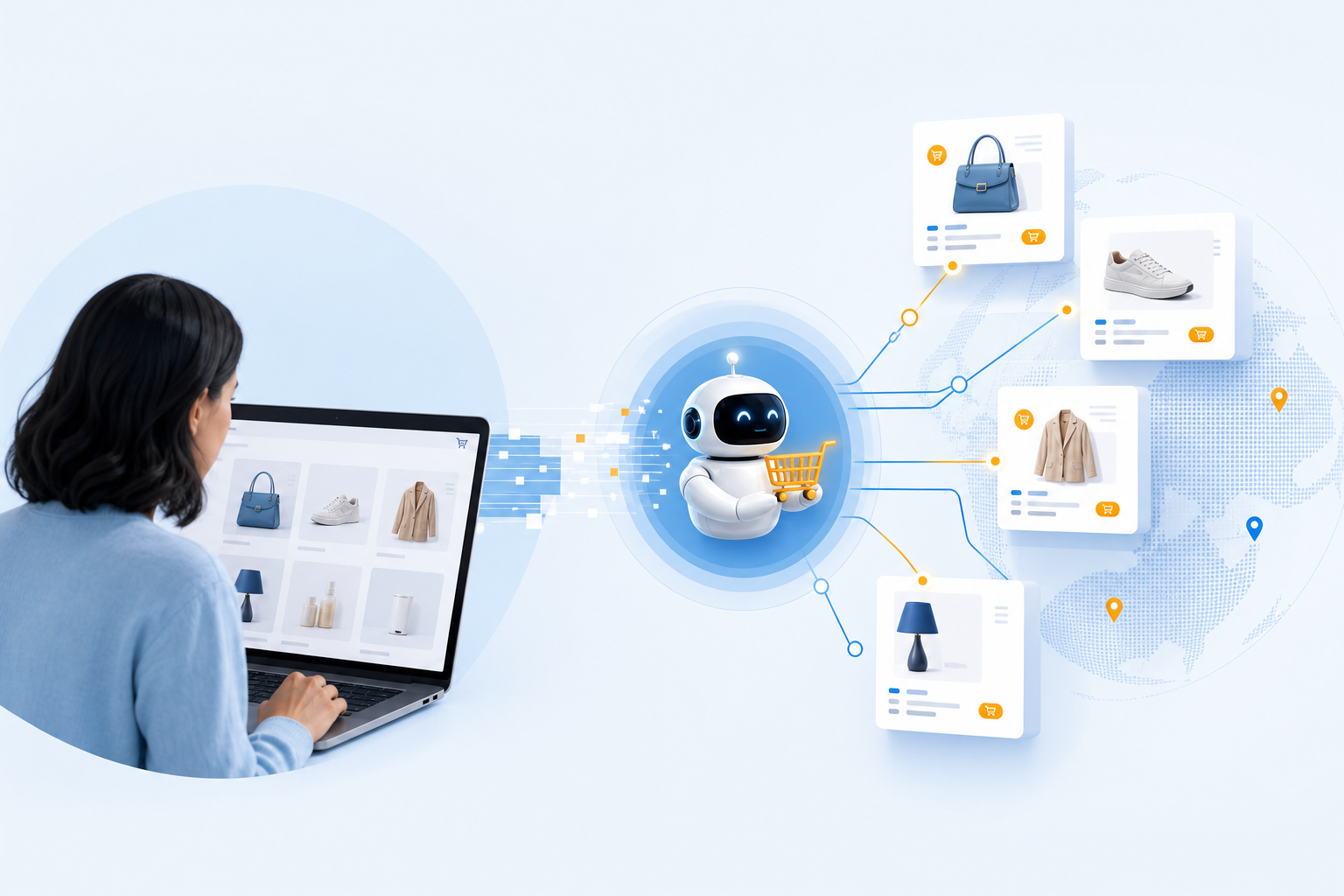
How does agentic commerce differ from traditional ecommerce? The core shift is this: agentic commerce replaces the human-driven browse-and-click funnel with an AI agent that researches, compares, and initiates checkout on the shopper's behalf, while traditional ecommerce optimizes pages for people. Agentic commerce requires structured, machine-readable data and protocol-ready endpoints so AI assistants can find, evaluate, and transact with your store. Both models run simultaneously today. The question for merchants is not which will win but what specifically must change in their stack, data, and strategy to serve both human browsers and AI agents.
What is the difference between agentic commerce and traditional ecommerce?
Traditional ecommerce puts the shopper in the driver's seat for every step: search, browse, compare, read reviews, and check out, all on interfaces designed for human eyes. Agentic commerce shifts the research legwork to an AI agent. The agent queries across stores, compares specs and policies, narrows the options, and presents a shortlist. The shopper still decides. The order still runs through the merchant.
That distinction matters because the two models require different optimization work. A traditional store competes for human attention through design, copy, and paid media. An agentic store competes to be the agent's answer, which means structured data, accurate feeds, and machine-readable policies.
The core differences, in brief:
- Who researches: the shopper, on your pages, versus an agent, across many stores at once.
- What you optimize: persuading people versus being readable, retrievable, and trusted by machines.
- Where discovery happens: search rankings and ads versus retrieval and citation inside an AI answer.
- What loyalty means: habit and remarketing versus being the agent's remembered default, re-earned on every purchase.
Nearly 132 million U.S. adults have completed retail purchases with AI assistance, according to PYMNTS Intelligence. That is not a pilot cohort. It is a channel that already exists in your analytics, likely undercounted.
How is agentic commerce different from the AI ecommerce already uses?
Ecommerce has run on AI for a decade: recommendation engines, personalization, site search, dynamic pricing, and support chatbots. All of it is merchant-side AI. It lives inside one store, works on that store's behalf, and sees only that store's shoppers and catalog. Its job is to help the merchant sell more to the people already on the site.
Agentic commerce adds shopper-side AI. Shopping agents such as ChatGPT, Perplexity, and Gemini work for the shopper, not the store. They compare across every merchant they can read, hold the full conversation about what to buy, and recommend whichever store answers best. A recommendation engine cannot suggest a competitor. A shopping agent does it by design.
That inversion is the structural difference. The merchant-side playbook, tune the funnel, personalize the page, does not transfer to a channel where the shopper's agent finishes the research before your page is ever visited.
Gartner forecasts that 33% of enterprises will adopt agentic AI technologies by 2028. Adoption is not evenly distributed: B2B commerce is moving faster, because procurement workflows already involve multi-step approvals and vendor comparisons that agents compress well. Agentic systems for commerce in B2B contexts handle RFQ matching, catalog comparison, and contract-term checks, tasks that previously required a human buyer's hours.
How does agentic commerce differ from traditional ecommerce personalization and product recommendation engines?
Recommendation engines are the most mature AI in retail, and they work well for what they were built to do. They watch behavior inside your store, infer intent, and surface products the shopper is likely to want. The merchant controls the model, the rules, and the catalog it draws from. The engine never looks outside your store.
Agentic AI inverts that setup. A shopping agent works across your entire category, not just your catalog. It compares your price against four competitors, reads your return policy against theirs, and decides whether to recommend you before the shopper ever visits your page. Your recommendation engine has no visibility into that process and no ability to influence it.
The loyalty implication is direct. Recommendation engines reinforce habit: a repeat buyer sees more of what they already purchased, and the engine deepens the relationship over time. An agent re-runs the comparison on every purchase. There is no accumulated preference. The merchant who wins is the one with the cleanest data, the most reliable stock, and the clearest policies, not the one with the most sophisticated personalization layer.
Adobe data shows that traffic from generative AI browsers and chat platforms to U.S. retail sites grew 4,700% year-over-year in July 2025. That traffic arrives pre-qualified. The agent already did the comparison. Personalization still matters once the shopper lands, but it no longer decides whether they arrive.
Interoperability protocols: UCP, MCP, and ACP explained
Three protocols now define how AI agents interact with merchant systems, and understanding what each one does helps you decide where to focus.
MCP (Model Context Protocol) is a protocol for connecting AI agents to external data sources. Shopify's Storefront MCP implementation exposes product and availability data directly to agents that support the protocol, so an agent querying Shopify-hosted stores can pull accurate specs without scraping HTML.
ACP (Agentic Commerce Protocol) handles the transaction layer. It defines how an agent sends a purchase intent to a merchant's endpoint and how the merchant responds. The merchant accepts or declines each order, charges through its existing payment processor, and handles fulfillment. The protocol changes where the buy button appears, not who runs the store.
UCP (Universal Checkout Protocol) covers delegated payment credentials. Stripe Agentic Commerce provides the infrastructure for this flow, including the credential issuance and validation steps.
The trust gap is real. Visa research via a Harris Poll of 2,065 U.S. consumers found that only 23% trust generative AI to handle payment transactions. That number shapes how merchants should frame agentic checkout: as a confirmation step the shopper approves, not an autonomous purchase the agent makes alone.
For a deeper look at what MCP means for your product data publishing strategy, see how the Model Context Protocol changes what ecommerce stores need to publish.
What companies are using agentic commerce today?
Adoption is broader than the enterprise-only narrative suggests. Checkout.com reports that 42% of merchants have begun testing agentic commerce solutions, which means the question is no longer whether to engage but how.
The platforms in active production cover a range of use cases:
Shopify offers native protocol support for UCP, Storefront MCP, and AP2, making it the most accessible entry point for mid-market merchants who want agent-readable storefronts without custom infrastructure. Per aissist.io, headless-leaning enterprises may find the platform constraints limiting for complex business logic.
Mirakl serves retailers and B2B enterprises with AI-powered catalog management, supplier onboarding, and marketplace scaling. B2B is a particularly active segment: procurement workflows involving multi-step approvals and vendor comparisons map well onto what agentic systems for commerce do best.
Salesforce Agentforce Commerce uses autonomous agents to anticipate customer needs and execute personalized shopping experiences within the Salesforce ecosystem. It requires unifying data across commerce, marketing, and service into a single format, per salesforce.com, which makes it a better fit for organizations already running Salesforce end-to-end.
Stripe Agentic Commerce provides the payment infrastructure layer: programmatic commerce flows and delegated payment credentials that let agents authenticate and pay without interrupting the shopper.
| Tool | What it does for agentic commerce | Runs on | Price tier |
|---|---|---|---|
| Mirakl | AI-powered catalog management, supplier onboarding, marketplace scaling | Cloud | Paid plan |
| Shopify Agentic Commerce | Native UCP, Storefront MCP, and AP2 support for AI discovery and checkout | Cloud | Paid plan |
| Stripe Agentic Commerce | Delegated payment credentials and programmatic commerce flows | Official API | Not publicly listed |
| Salesforce Agentforce Commerce | Autonomous agents for personalized shopping within the Salesforce ecosystem | Cloud | Not publicly listed |
Market growth forecasts: where agentic commerce is headed by 2030
McKinsey projects the U.S. B2C retail market for agentic commerce will reach $1 trillion by 2030. That figure covers U.S. B2C only. Global B2B agentic commerce, where procurement automation is already further along, sits outside that estimate.
The consumer adoption baseline supports the trajectory. Nearly 132 million U.S. adults have already completed retail purchases with AI assistance. That is not a forecast. It is the current state of the channel.
What the forecasts do not tell you is how revenue splits between merchants who prepared and those who did not. An agent comparing ten stores in your category routes orders to the ones with accurate feeds, clear policies, and protocol-ready endpoints. The $1 trillion does not distribute evenly. Merchants who are machine-readable capture a disproportionate share; those who are not become invisible before the shopper ever considers clicking through.
How to prepare your store for agentic commerce
Preparation means making your store machine-answerable. Agents reward what good comparison engines always have, only more literally: accurate data, clear policies, and endpoints they can reach.
Start with access. Check your robots.txt and CDN bot rules to confirm you allow OAI-SearchBot and PerplexityBot. If those crawlers cannot read your pages, no amount of structured data matters.
Then work through your product data. Prices, availability, variants, specs, and return and shipping policies should all be on stable, crawlable URLs. Feed coverage is the new crawl budget: an agent that cannot parse a product skips it. Keep your feeds consistent with your PDPs, because an agent that finds a price mismatch between your feed and your page loses confidence in both.
Track AI referrers separately. Agent-sourced visits often arrive as direct traffic in GA4 because the referrer is stripped. Segment by known AI assistant domains so agentic traffic stops hiding in your baseline numbers.
Then test from the outside. Ask ChatGPT or Perplexity to compare products in your category and note whether your store appears, what it says about you, and whether the information is accurate. That test costs nothing and shows you exactly what an agent-referred shopper sees before they ever reach your site.
Aigency is a platform that builds a parallel, agentic version of your website on your own subdomain, designed to handle visitors referred by AI assistants like ChatGPT and Perplexity. It crawls your existing site using vision-based agents, no code integration required, and creates a surface that can hold a natural language conversation with shoppers and guide them to checkout. The scan that shows where your current pages fail AI-referred visitors is free.
The practical priority is not building a new storefront. It is making sure the one you have is readable before the next agent comparison runs in your category.
Prices and plan limits verified as of October 2026.
FAQs
Is agentic commerce replacing traditional ecommerce?
No. Both models run simultaneously, and the mix is the point. A large share of purchases still follow the conventional browse-and-click path, while AI-assisted buying is already a measurable channel in most retailers' analytics. The dominant 2026 pattern is to discover and shortlist in AI, then complete the purchase on the merchant's own site. Optimizing for one channel at the expense of the other is the wrong framing.
Do AI-referred shoppers actually convert better than regular traffic?
Adobe data shows that traffic from generative AI browsers and chat platforms to U.S. retail sites grew 4,700% year-over-year in July 2025. Visitors arrive pre-qualified because the agent already ran the comparison before the click. Conversion quality tends to be higher for that reason, though results vary by category, price point, and how machine-readable your product data is.
What is Visa agentic commerce?
Visa Intelligent Commerce is Visa's program for enabling AI-assisted payments. Visa research via a Harris Poll of 2,065 U.S. consumers found that only 23% currently trust generative AI to handle payment transactions, which is why the credential model is designed as a shopper-approved confirmation step rather than a fully autonomous purchase.
How is agentic AI different from traditional automation?
Traditional ecommerce automation, think order routing, email triggers, and restock alerts, executes predefined rules inside a single system. An agentic AI executes a chain of tasks across multiple systems and data sources, adapting its path based on what it finds. It does not follow a script. It pursues a goal: find the best option for this shopper, given these constraints, across every store it can read. The scope and autonomy are categorically different.
If an AI agent buys from my store, do I lose the customer relationship?
Not structurally. Under protocols like ACP, the merchant accepts or declines each order, charges through its own payment processor, ships the order, and handles returns and support. You remain the seller of record. What does change is loyalty: an agent re-runs the comparison on every purchase, so there is no accumulated habit. The merchants who keep the relationship are the ones with reliable stock, honest pricing, and clear policies, because those are the signals the agent reads every time.
Conclusion
Agentic commerce does not replace traditional ecommerce. It adds a second channel that runs in parallel, one where an AI agent does the research before the shopper ever visits your store. The core shift is not in checkout mechanics. It is in where discovery, trust, and loyalty are now built.
The practical next step is finding out how your store looks to an agent today. Check whether your AI-referred traffic is tracked separately, run a comparison query in ChatGPT or Perplexity for your category, and audit whether your product feeds match your PDPs. Those three checks show you where the gaps are before they cost you orders.
https://aigency.ai/blog/agentic-commerce-vs-traditional-ecommerce