ENGINEERING · · 9 min read
How the Model Context Protocol Changes What Ecommerce Stores Need to Publish
By Riki Gertzik
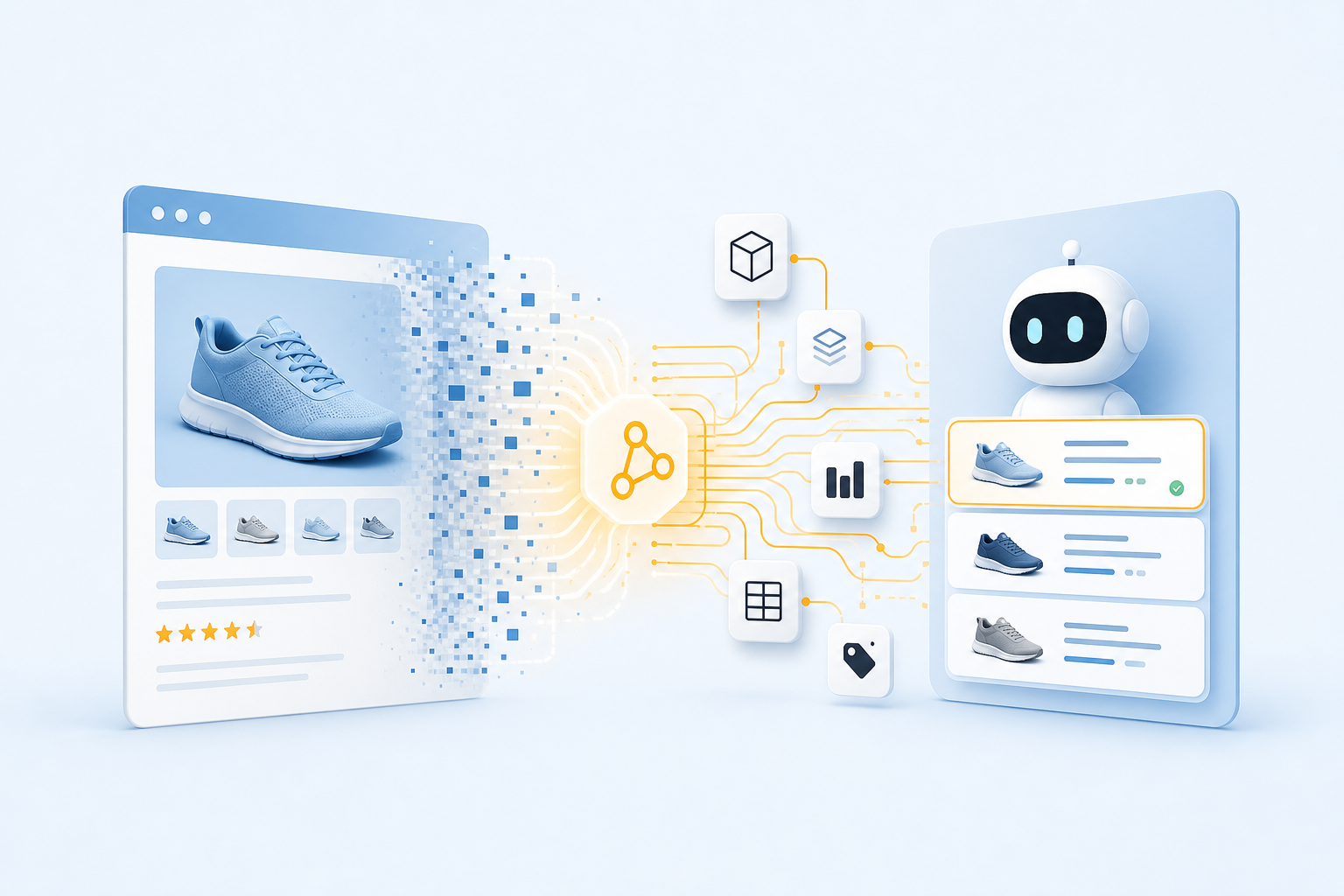
The Model Context Protocol is not a marketing concept. It is a technical specification, and it changes what your store needs to publish if you want AI assistants to work with your product data rather than around it.
MCP ecommerce adoption is still early, but the structural shift it represents is already affecting which brands get accurate, complete responses from ChatGPT, Gemini, Claude, and Perplexity, and which get approximations built from whatever those models could scrape.
If you run a DTC brand and you have been investing in SEO or generative engine optimization, this is the next layer down. Understanding MCP means understanding what AI assistants actually need from you, not just what they can find.
What MCP Actually Is
The Model Context Protocol is an open standard, originally developed by Anthropic, that defines how AI models connect to external data sources and tools. Think of it as a standardized handshake between a model and a data provider.
Before MCP, every integration between an AI assistant and an external system was custom. If you wanted Claude to read your product catalog, someone had to build a bespoke connector. MCP replaces that with a shared protocol, so any model that supports it can connect to any MCP-compatible data source without custom engineering on either side.
For ecommerce, the practical implication is significant. An AI assistant that supports MCP can, in principle, query your product catalog directly, pull current pricing, check inventory status, and retrieve structured product attributes, all without relying on a cached or crawled version of your site.
The click happens. Whether the sale follows depends on whether the model had accurate information when it made its recommendation.
The Publishing Problem MCP Exposes
Most ecommerce stores publish product information in two forms: rendered HTML pages for human visitors, and structured data markup (typically Schema.org) for search engines. Both were designed for a world where the consumer of that data was either a human browser or a traditional crawler.
AI assistants are neither.
When ChatGPT or Perplexity references your product in a response, it draws on a combination of training data, web crawl snapshots, and, increasingly, real-time retrieval. None of those sources reliably reflect your current catalog state. A product you discontinued six months ago may still appear in AI-generated recommendations. A formulation you updated may still be described using the old ingredient list. A price that changed last quarter may still be cited.
MCP creates a path to fix this. But only if you publish data in a way that an MCP-compatible system can actually consume.
What Static Pages Cannot Do
A static product page is optimized for a human reading it. The information is there, but it is embedded in layout, navigation, imagery, and marketing copy. A model trying to extract structured facts from that page has to interpret it, and interpretation introduces error.
Schema.org markup helps, but it was designed for search engine indexing, not conversational retrieval. It does not handle relational queries well. It does not expose inventory in real time. It does not surface the comparison attributes a shopper asking "which of your sunscreens works best for oily skin" actually needs.
MCP-compatible endpoints can expose exactly that kind of structured, queryable product data. The question is whether your store is set up to provide it.
What Stores Need to Publish for MCP Compatibility
This is not a complete technical specification. It is a practical orientation for operators thinking about what to prioritize.
Structured Product Attributes, Not Marketing Copy
MCP queries are attribute-based. A model asking about your skincare line wants to know SPF value, skin type compatibility, active ingredients, texture, and finish. It does not want your brand story.
Your product data layer needs to hold those attributes explicitly, not buried in a paragraph of copy. If your product descriptions say "perfect for sensitive skin" but your data model has no formal skin-type field, an MCP query will either miss that attribute or extract it unreliably.
The publishing requirement here is upstream of MCP itself. Your product information management (PIM) system or commerce backend needs to hold structured attributes that can be exposed through an API or MCP endpoint. If your catalog lives entirely in Shopify's description field as free text, you have a data structure problem before you have an MCP problem.
Real-Time Inventory and Pricing
One of the most common failure modes in AI-assisted shopping is stale data. A shopper asks ChatGPT to recommend a product, the model recommends yours, the shopper arrives and finds it out of stock or priced differently than stated.
MCP addresses this by allowing a model to query live data rather than rely on a crawl snapshot. But your store has to expose that data through an endpoint the model can reach.
For most Shopify stores, this means using the Storefront API or a custom MCP server that wraps your catalog. For headless stacks, you likely already have an API layer, and the work is configuring it to be MCP-compatible. The underlying requirement is the same: real-time data, queryable by attribute, accessible without authentication barriers that block automated clients.
Comparison and Fit Logic
This is the layer most stores are missing entirely, and it matters more than anything else for considered-purchase categories.
When a shopper asks "which of your protein powders is best for someone who works out in the morning and wants to avoid bloating," that is not a keyword query. It is a multi-attribute filtering problem with a preference layer on top. A static page cannot answer it. A keyword search cannot answer it. An AI assistant can, but only if the underlying data exposes the attributes the logic requires.
Publishing for MCP compatibility means thinking about what comparison questions your shoppers actually ask, then making sure the attributes that answer those questions exist as structured fields in your data, not as sentences in a product description.
If you are not sure what questions your AI-referred visitors are already asking, that is exactly the kind of gap a structured analysis can surface. Aigency's free site scan identifies the specific questions AI-referred visitors are asking that your existing static pages fail to answer. That output is a useful starting point for understanding which attributes your data model is missing.
Content That Explains, Not Just Describes
MCP handles structured data well. It handles unstructured explanatory content less well, but that content still matters for the conversational layer.
When a model generates a recommendation, it often needs to explain why. "This moisturizer is a good fit because it is fragrance-free and formulated for combination skin" requires both structured attributes and the ability to construct a coherent explanation. The structured attributes come from your data. The explanation quality depends partly on what your published content teaches the model about your products.
Your product pages, FAQ content, and comparison guides still matter, but they matter differently than they did for SEO. You are not writing for a human scanning a page. You are publishing information a model will use to construct an accurate, helpful response. Clarity and specificity beat length and keyword density.
The Subdomain and Endpoint Question
One practical question MCP raises is where to host the endpoint that AI assistants will query.
Your main storefront is built for human visitors. It is optimized for conversion, not machine-readable data delivery. Mixing those two concerns on the same domain creates tradeoffs that are hard to manage cleanly.
A separate agentic layer, hosted on a subdomain, can serve both purposes: it handles AI-referred human visitors conversationally, and it exposes structured data to autonomous agents and MCP-compatible systems. The two functions are architecturally compatible because they share the same underlying product data, but they serve it through different interfaces.
This is the premise behind agentic commerce infrastructure: the interface layer for AI-mediated commerce is distinct from the interface layer for direct human browsing, and trying to serve both from a single static storefront creates gaps that neither SEO nor traditional conversion optimization can close.
What WebMCP Signals About Where This Is Going
The extension of MCP to web contexts, sometimes called WebMCP, is worth paying attention to if you are thinking about this infrastructure question over a two-to-three year horizon. The full discussion of what WebMCP actually signals is longer, but the short version is this: the direction of travel is toward AI assistants that can transact on a user's behalf, not just recommend.
When that becomes common, the stores that have invested in MCP-compatible data publishing will have a structural advantage. Their product data will be queryable, accurate, and complete. Their inventory and pricing will be real-time. Their comparison logic will be machine-readable.
The stores that have not done this work will still be serving AI assistants a rendered HTML page and hoping the model interprets it correctly.
The Composable Commerce Angle
If you are running a headless or composable stack, you are closer to MCP readiness than a standard Shopify store, but not automatically there. Having an API layer does not mean having an MCP-compatible one. The protocol has specific requirements around how tools and resources are exposed, and most commerce APIs were not designed with those requirements in mind.
The relevant question for composable operators is whether your existing API layer can be adapted to serve as an MCP server, or whether you need a separate service to handle that. Composable commerce in 2026 and its relationship to AI-agent shopping is a useful frame for thinking through that decision.
For most DTC brands in the $1 million to $20 million revenue range, the answer is probably a pragmatic middle path: structured product data improvements in your existing system, a lightweight MCP-compatible endpoint for the attributes that matter most to AI-assisted queries, and a conversational layer that handles the AI-referred human visitors who arrive expecting to continue the conversation the AI assistant started.
Where to Start
If you are trying to figure out what to prioritize, here is a reasonable sequence.
First, audit your product data structure. Identify which comparison attributes your shoppers ask about and check whether those attributes exist as structured fields or only as free text in descriptions. This is the foundational work everything else depends on.
Second, assess your real-time data exposure. Can an automated client query your current inventory and pricing without hitting a rendered HTML page? If not, that is the next gap to close.
Third, think about your conversational layer. AI-referred visitors arrive with context and expectations that a static product page was not built to meet. Whether you address that through an MCP endpoint, an agentic subdomain, or both depends on your stack and your traffic volume. Ignoring it means losing the conversion on visitors who already had a reason to trust your brand.
The stores that treat MCP as a publishing problem rather than a technology problem will get there faster. It is fundamentally about what data you expose, how you structure it, and whether the systems AI assistants use can actually reach it.
To understand the specific gaps in your current setup, the free scan at aigency.ai surfaces the questions AI-referred visitors are already asking that your existing pages cannot answer. That is a concrete starting point, not a theoretical one.
Frequently Asked Questions
What is the Model Context Protocol and why does it matter for ecommerce? The Model Context Protocol (MCP) is an open standard that defines how AI models connect to external data sources. For ecommerce, it matters because it creates a path for AI assistants to query your live product data directly, rather than relying on crawled or cached versions of your site that may be outdated or incomplete.
Do I need to be a developer to make my store MCP-compatible? Not entirely, but some technical work is involved. The foundational requirement is structured product data: attributes stored as discrete fields rather than embedded in free-text descriptions. For most Shopify stores, that means improving your product data model first. Exposing that data through an MCP-compatible endpoint typically requires API configuration, which involves developer involvement unless you use a platform that handles it for you.
How is MCP different from Schema.org structured data? Schema.org markup is designed for search engine indexing. It is static, embedded in your HTML, and not queryable in real time. MCP is a protocol for live, two-way data exchange between an AI model and a data source. Schema.org tells a crawler what your page contains. An MCP endpoint lets a model ask your catalog a question and get a current answer.
What product data should I prioritize structuring first? Start with the attributes your shoppers use to make comparison decisions: ingredients, fit, compatibility, use case, and similar. These are the attributes AI assistants need to generate accurate recommendations. Pricing and inventory come next, because stale data on those two fields creates the most visible trust problems when a shopper arrives after an AI recommendation.
Does MCP replace my existing storefront? No. MCP is a data-access layer, not a storefront replacement. Your existing site continues to serve human visitors who arrive through search, social, and direct channels. MCP-compatible endpoints serve AI assistants and autonomous agents that need structured, queryable data. The two functions are complementary, not competing.
What is the connection between MCP and agentic commerce? MCP is part of the infrastructure that makes agentic commerce possible. An AI agent that can transact on a user's behalf needs to query live inventory, confirm pricing, and check product compatibility in real time. MCP provides the protocol for those queries. Stores that build MCP-compatible data layers now are positioning themselves for a future where AI agents do more than recommend, they complete purchases.
How do I find out which questions AI-referred visitors are already asking about my products? A structured gap analysis is the most direct method. Aigency's free site scan identifies the specific questions AI-referred visitors are asking that your existing static pages fail to answer, which gives you a concrete list of the attributes and content gaps to address first.
https://aigency.ai/blog/model-context-protocol-ecommerce-publishing