Playbook · · 7 min read
Agentic Commerce ROI: How to Make the Business Case Stick
By Itamar Weisbrod
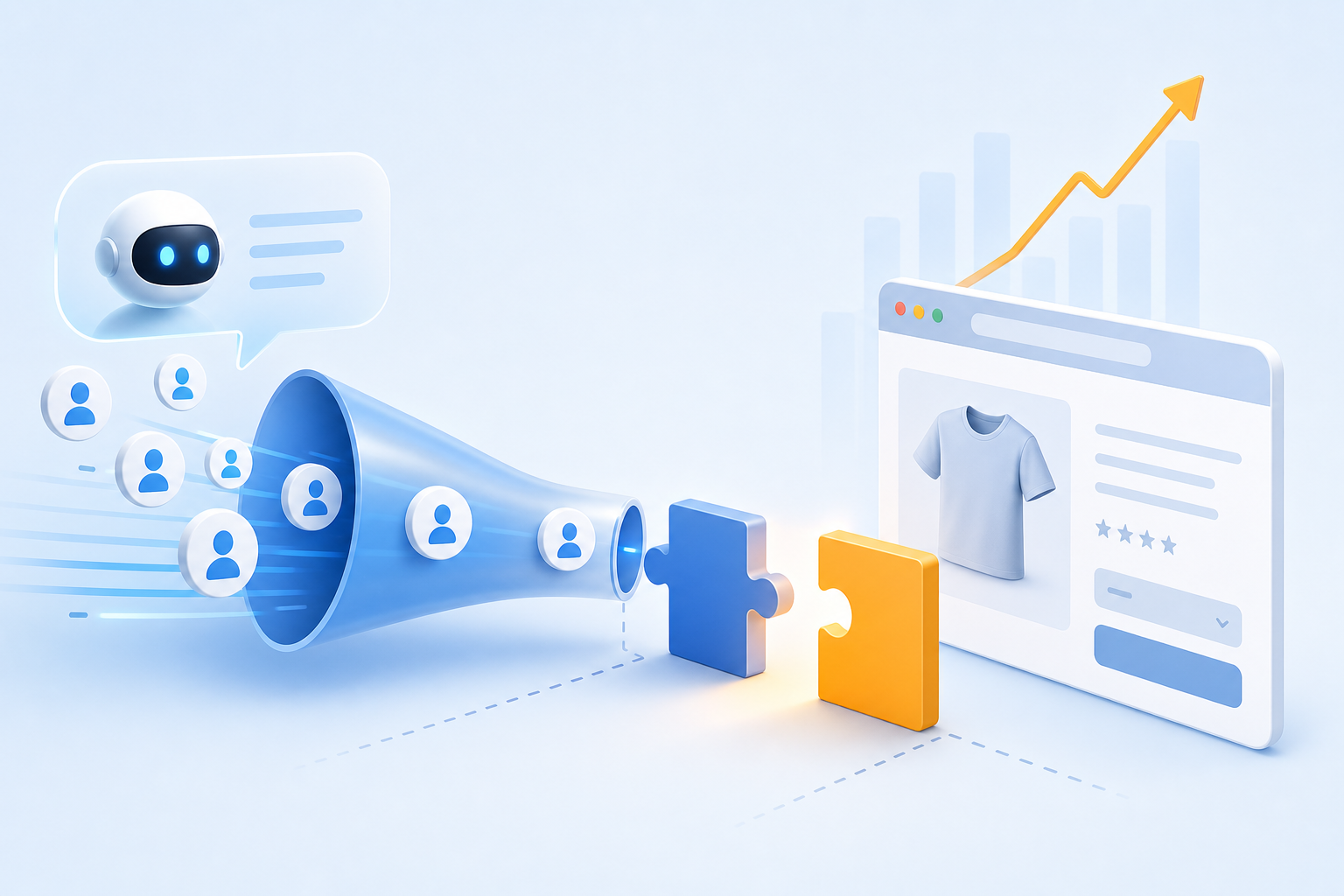
The business case for agentic commerce ROI is harder to make than it looks. Not because the opportunity is unclear, but because the measurement frame most operators reach for first is the wrong one.
If you run a DTC brand between $1M and $20M in annual revenue, you have probably noticed AI-referred traffic in your analytics. ChatGPT, Perplexity, Gemini, Claude. The sessions exist. The question is whether they convert, and whether you have built anything to help them do so.
This article covers how to frame the ROI case correctly, what inputs you actually need, and where the business case tends to break down before it reaches a decision.
Why the Standard CRO Frame Does Not Apply Here
Most conversion rate optimization logic assumes a static funnel. A visitor lands on a product page, reads the copy, and either buys or leaves. You optimize the page. You A/B test the headline. You improve the CTA.
AI-referred visitors do not behave that way. They arrive mid-conversation. A shopping agent or a human using ChatGPT has already asked a specific question, received a recommendation, and followed a link. By the time they reach your site, they have context your product page was never designed to continue.
This is not a traffic quality problem. It is a structural mismatch. The visitor is ready to go deeper. The page cannot go anywhere.
That gap is where agentic commerce ROI lives. The standard CRO playbook, optimizing static pages for anonymous intent, measures the wrong thing entirely. For a fuller breakdown of why traditional conversion optimization fails this traffic segment, the piece on ecommerce conversion optimization in the age of AI covers the mechanics in detail.
The Three Inputs Your Business Case Actually Needs
Before you can make the case internally, you need three numbers. Most operators have one of them. Few have all three.
1. How Much AI-Referred Traffic You Are Already Receiving
Pull your GA4 source/medium data and look for referrals from ChatGPT, Perplexity, Claude, and Gemini. If you are already investing in SEO or generative engine optimization content, this number is probably larger than you expect. Adobe Analytics reported that AI-driven referrals to retail sites grew over 800% year-on-year, which means even a modest share of that growth represents meaningful session volume for a brand your size.
The point is not to impress anyone with the percentage. The point is to establish that this traffic already exists in your funnel and is currently landing on pages that were not built to handle it.
2. What Those Visitors Are Actually Asking
This is the input most operators are missing. You can see that AI-referred sessions are bouncing. You cannot see why, because your static pages do not record the question that preceded the visit.
The practical way to surface this is a gap analysis: a structured look at the questions AI assistants are generating about your product category, mapped against what your existing pages actually answer. Aigency's free site scan does exactly this. It produces a brand-specific report showing which questions AI-referred visitors are asking that your current pages cannot answer. That report is available before any purchase decision, and it gives you the specific input your business case needs.
Without this data, your ROI model is built on assumptions. With it, you are working from documented demand.
3. The Revenue Value of Closing That Gap
Once you know the session volume and the question gap, the math is straightforward. Take your current AI-referred traffic volume. Apply a realistic improvement in conversion rate if those visitors could continue the conversation they started. Multiply by your average order value.
You do not need a large improvement to justify the investment. If you are receiving a few thousand AI-referred sessions per month and your average order value sits between $80 and $150, even a modest shift in conversion rate produces a number worth taking seriously.
The honest caveat: this is a projection, not a guarantee. The projection is only as good as the inputs, which is why the gap analysis matters before the model.
What the Business Case Tends to Get Wrong
Treating It as a Technology Expense
Agentic commerce infrastructure is not a software cost. It is a revenue capture mechanism for a traffic segment that is already arriving and currently converting at a fraction of its potential.
Frame it as lost revenue recovery, not as a new capability purchase. The sessions are happening. The question is whether you are equipped to handle them.
Requiring Integration Work to Justify the Cost
One of the more common objections in a business case review is the hidden cost of implementation. Developer time, platform integration, QA cycles. These costs are real for most tools in this category, and they belong in any total cost of ownership calculation.
Aigency's deployment model removes most of this. Vision-based crawling agents read your rendered site the way a human visitor would. No code integration. No database access. No IT involvement. The agent site goes up on your own subdomain (ai.yourbrand.com) without touching your existing stack. That changes the cost side of the equation materially.
Comparing Against a Chatbot Engagement Layer
If your internal conversation is about whether to add a chat widget to your existing product pages, you are solving a different problem. A chat overlay on a static page is still a static page with a box on it. It cannot continue the conversation an AI assistant started, because it has no context for what that conversation was.
An agentic storefront is a parallel site, hosted separately, built to receive visitors who arrive with a specific question already in hand. The comparison is not widget versus widget. It is whether you have a destination built for this traffic at all.
Where Agentic Commerce Fits in a Broader Infrastructure Decision
For brands on Shopify or headless commerce stacks, agentic commerce infrastructure does not replace what you have. It runs alongside it, on a subdomain, serving a specific visitor segment that your main site was not designed for.
This matters for the business case because the decision is additive, not architectural. You are not replatforming. You are adding a purpose-built layer for a traffic type that is growing fast and converting poorly on static pages.
The headless commerce versus agentic infrastructure comparison is worth reading if your team is already debating infrastructure direction. The two decisions are related but not the same, and conflating them tends to stall both.
The Control Question Every Finance Review Will Ask
At some point in any internal business case, someone will ask: what happens if the agent says something wrong?
This is a fair question. The answer needs to be specific.
Aigency's Policy and Control Agent lets you define exactly what the agent can say, what it must never say, and where it directs users. This is not a general content filter. It is a merchant-controlled guardrail layer that governs agent behavior at the product and category level. That specificity matters when you are presenting to a finance or legal stakeholder who wants to understand the risk surface.
The Monitoring Agent adds a second layer of operational confidence. It watches your main site and updates the agent site when content changes, using crawl-based detection rather than a live database sync. When your pricing or product details change, the agent site follows without manual intervention.
The Measurement Framework That Actually Holds Up
Once you have deployed an agentic storefront, the measurement question shifts from projection to attribution. Here is the frame that tends to survive scrutiny.
Segment your AI-referred traffic. Compare conversion rates for sessions that engaged with the agent site against AI-referred sessions that landed on your static pages. Hold average order value and traffic source constant. The delta is your operational ROI signal.
This is not complicated. It requires clean source tagging in GA4 and a clear subdomain boundary. Both are achievable without custom development.
The broader question of how AI assistants are changing the purchase path, and what that means for the next two years of commerce infrastructure, is covered in the agentic commerce myth piece on the Aigency blog. It is useful context for anyone building a longer-horizon case.
What the Business Case Needs to Say
A strong internal case for agentic commerce investment covers four things.
First, the traffic reality: AI-referred sessions are already in your funnel, growing, and converting below their potential on static pages.
Second, the gap: your existing pages cannot continue the conversation those visitors arrived with, and you have documented evidence of the specific questions they are asking.
Third, the cost structure: deployment requires no code integration, no developer involvement, and no replatforming, which removes the implementation cost that typically inflates the denominator in this kind of ROI calculation.
Fourth, the control layer: the agent operates within defined guardrails, updates automatically when your site changes, and runs on your own subdomain under your brand.
That is a business case built on specifics. It does not require you to project large conversion lifts or make claims you cannot support. It requires you to show that a documented traffic segment is currently underserved, that the cost of serving it is lower than alternatives, and that the operational risk is bounded.
The click happened. Now you need a site that can handle what comes next.
Start with the free site scan at aigency.ai to see exactly which questions your AI-referred visitors are asking that your current pages cannot answer.
Frequently Asked Questions
What is agentic commerce ROI and how is it measured? Agentic commerce ROI is the return generated by deploying infrastructure specifically designed to convert AI-referred visitors. It is measured by comparing conversion rates for AI-referred sessions that engage with a purpose-built agent site against AI-referred sessions that land on static product pages, holding traffic source and average order value constant.
Why does standard conversion rate optimization fail for AI-referred traffic? AI-referred visitors arrive mid-conversation, having already asked a specific question and received a recommendation. Static product pages have no mechanism to continue that conversation. Standard CRO optimizes the page itself, which does not address the structural mismatch between what the visitor expects and what the page can deliver.
What inputs do I need to build an agentic commerce business case? Three inputs: the volume of AI-referred traffic already arriving on your site, a documented list of the specific questions those visitors are asking that your existing pages cannot answer, and a revenue projection based on your current average order value and a realistic conversion rate improvement.
Does deploying an agentic storefront require replatforming or developer work? Not with Aigency. The platform uses vision-based crawling agents that read your rendered site without code integration, database access, or IT involvement. The agent site is deployed on your own subdomain and runs alongside your existing stack without touching it.
How does an agentic storefront differ from a chat widget on a product page? A chat widget sits on top of a static page and has no context for the conversation a visitor arrived with. An agentic storefront is a separate site, hosted on a subdomain, built to receive visitors who already have a specific question and continue that conversation through to purchase.
How do I control what the agent says? Aigency's Policy and Control Agent lets you define what the agent can say, what it must never say, and where it directs users. This operates at the product and category level, giving you explicit guardrails rather than a general content filter.
What happens when my product catalog or pricing changes? The Monitoring Agent watches your main site and updates the agent site when content changes, using crawl-based detection. You do not need to manually update the agent site each time your main site changes.