Playbook · · 8 min read
AI Shopping Agent vs AI Chatbot: Why the Architecture Behind the Conversation Decides Your Conversion Rate
By Itamar Weisbrod
The visitor arrived from ChatGPT. They had already done research. They had a specific question about ingredient compatibility, sizing, or whether the product worked for their use case. Then they landed on your product page. The page said nothing back. The click happened. The sale did not.
This is not a traffic problem. It is an architecture problem. Understanding the difference between an AI shopping agent and an AI chatbot is the fastest way to see why your conversion rate is not moving even as AI-referred traffic grows.
Two Different Things That Sound Similar
The terms get used interchangeably. They should not be.
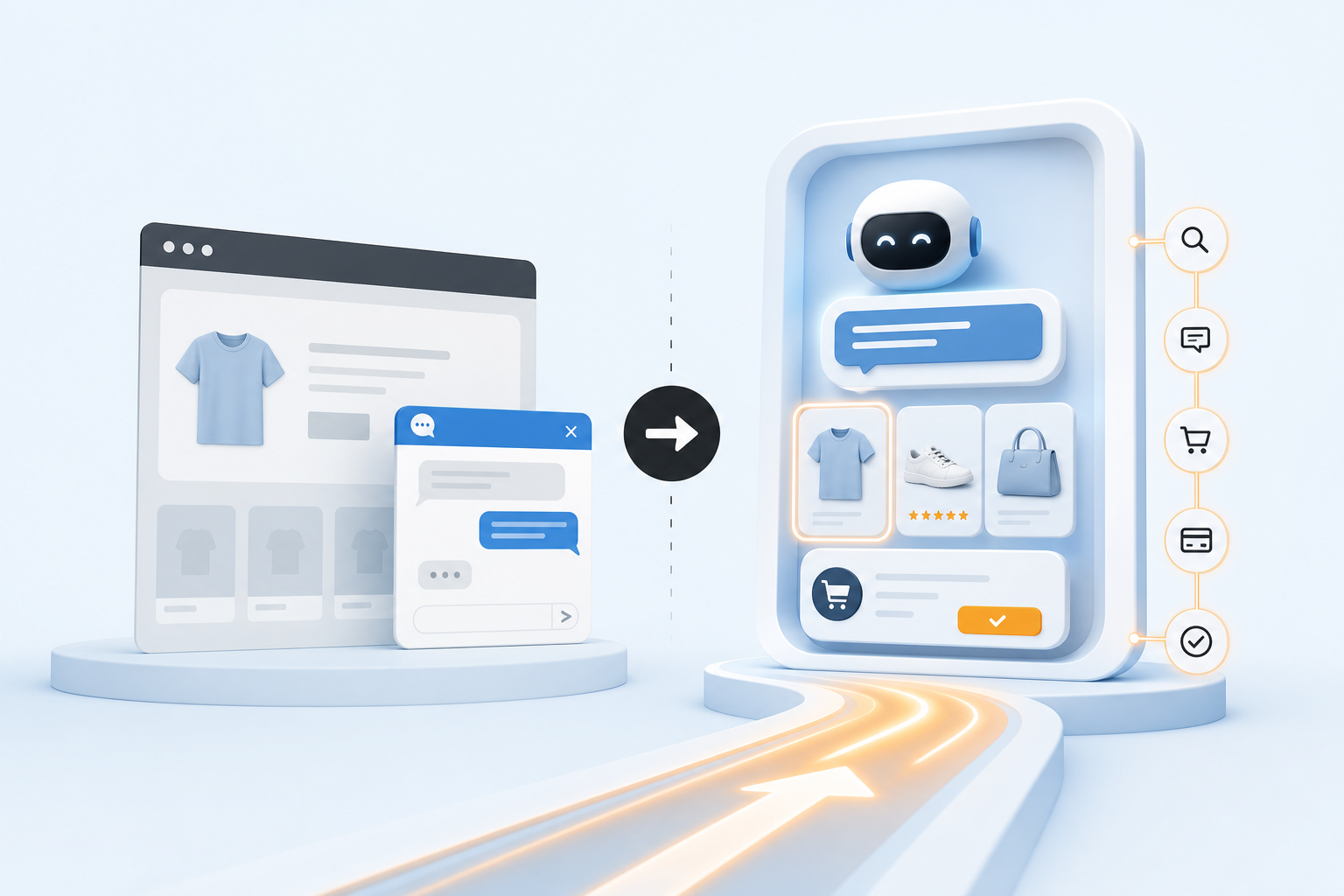
A chatbot is a widget. It sits on top of your existing storefront, responds to typed questions, and is constrained by whatever you have scripted or trained it on. The page underneath it is still static. The shopper still has to navigate your existing site structure to complete a purchase.
An AI shopping agent is architecturally different. It does not sit on top of your site. It operates as a separate environment that can hold a full natural language conversation, surface relevant products, answer comparison questions, and hand the shopper off to checkout when they are ready. The conversation is the interface, not an addition to one.
That distinction matters more than it sounds.
Why Architecture Is the Deciding Factor
When a shopper arrives from an AI assistant, they are not in browse mode. They already had a conversation with ChatGPT or Perplexity. They asked a question, got a recommendation, and followed a link. They arrive expecting the conversation to continue.
A static product page cannot do that. It presents information; it does not respond to it. A chatbot widget can respond, but it is doing so on top of a page designed for a different kind of visitor. The shopper still has to reconcile the widget's answer with the page layout, the navigation, the calls to action built for someone who arrived through Google.
An AI shopping agent built for this visitor type starts from a different premise. The conversation is the page. There is no underlying static structure to work around. The agent answers the question they arrived with, asks follow-up questions to narrow down the right product if needed, and guides them to checkout without asking them to shift mental modes.
Visibility Labs, analyzing 94 ecommerce brands across 12 months of GA4 data and reported via Search Engine Land, found that AI-referred visitors behave as a behaviorally distinct segment. They arrive with higher intent and lower patience for friction. An architecture that treats them like any other visitor leaves that intent on the table.
What a Chatbot Actually Does Well
This is not an argument against chatbots. They have real value.
A chatbot widget handles reactive support well. If a shopper on your product page wants to know your return policy or whether an item ships to their country, a chatbot can answer that without any infrastructure change. For post-purchase questions, sizing lookups, and FAQ deflection, a chatbot layer earns its place.
The problem is scope. Chatbots were designed for support, not sales. They were built to answer questions a shopper already had while browsing, not to serve as the primary interface for someone who arrived expecting a conversation to continue.
When a chatbot gets positioned as the solution to AI-referred traffic conversion, it is solving the wrong problem with the right-sounding tool.
What an AI Shopping Agent Actually Does
An AI shopping agent handles the full conversation arc from arrival to checkout. Here is what that looks like mechanically.
A shopper arrives from Perplexity, having asked about retinol products suitable for sensitive skin. They land on an agent site hosted at ai.yourbrand.com. The agent has full knowledge of your product catalog, ingredient lists, compatibility guidance, and variant options. It does not have to search for this information or approximate it. It was built from a crawl of your actual site.
The shopper types their question. The agent responds with a specific product recommendation, explains why it fits their stated concern, and offers to compare it against another option in your catalog. The shopper asks a follow-up. The agent answers it. The shopper adds to cart and goes to checkout on your existing store.
No static page was involved. No navigation menu. No product grid to parse. The friction between arriving and buying was reduced to the length of a conversation.
That is the architecture difference. Not a widget responding to a question. A separate environment built to hold the conversation from start to finish.
The Maintenance Problem Nobody Talks About
There is a second architectural issue that gets less attention: keeping the conversational layer current.
A chatbot trained on your product catalog in March is out of date by June. New SKUs, discontinued variants, updated ingredient lists, changed pricing. Every change to your main site creates a gap between what the chatbot knows and what is actually true. Most operators either accept that gap or assign someone to manually update the bot, which is a task that rarely gets prioritized correctly.
An AI shopping agent built with a monitoring layer solves this differently. Aigency's Monitoring Agent watches your main site and automatically updates the agent site when content changes. Your catalog changes; the agent site reflects it. No manual sync. No stale answers.
This is not a minor convenience feature. Stale product information in a conversational interface is a direct path to abandoned carts and support tickets. An architecture that handles currency automatically removes a category of failure that chatbots routinely introduce.
Control and Brand Safety
Operators who have looked at AI tools for their storefront often raise the same concern: what if it says something wrong?
It is a fair question. A chatbot with a large language model underneath it can hallucinate. It can make claims your product does not support. It can recommend a competitor. It can answer a question about your return policy incorrectly and create a customer service obligation you did not intend.
An AI shopping agent with a policy layer handles this differently. Aigency's Policy and Control Agent lets you define explicitly what the agent may say, what it must never say, and where it directs shoppers. You are not relying on probabilistic guardrails. You are setting hard rules the agent operates within.
For DTC brands in regulated categories like supplements or skincare, this is not optional infrastructure. It is the difference between a tool you can deploy and one that creates legal exposure.
The Subdomain Architecture and Why It Matters
One specific architectural choice separates an AI shopping agent from a chatbot overlay: where it lives.
A chatbot lives on your existing domain, on your existing pages. It is constrained by the structure of those pages and the context they provide.
An AI shopping agent deployed on a subdomain (ai.yourbrand.com) is a separate environment. It has its own URL structure, its own conversation flow, its own ability to present product information in whatever format the conversation requires. It is not fighting the layout of a page designed for a different visitor type.
This matters specifically for AI assistant referrals. When ChatGPT or Gemini refers a shopper to your brand, they can link directly to the agent site. The shopper lands in an environment built for the conversation they were already having. No context switch.
If you are tracking AI referral traffic and trying to understand why conversion is lower than expected, this is often the structural explanation. The visitor arrived ready to talk. They landed somewhere that could not talk back. For a closer look at how AI-referred visitors behave differently from organic traffic, AI Search Traffic E-Commerce: Why ChatGPT Visitors Convert 4.4x Better is worth reading alongside this.
Visual Search as a Conversion Layer
One capability that separates a purpose-built AI shopping agent from a chatbot is visual search.
A shopper who arrives from an AI assistant may not have a precise product name. They may have a reference image: a screenshot, a photo of something they saw, a picture of a color or style they want to match. A chatbot cannot process that input. It is a text interface.
An AI shopping agent with visual search built in can accept an image upload and search your product catalog by what the shopper shows it. The shopper does not need to know your taxonomy or naming conventions. They show the agent what they want, and the agent finds the closest match in your catalog.
This is not a feature you can add to a chatbot widget. It requires a different underlying architecture, one where the agent has structured access to your full catalog and can run image-based queries against it.
Where Chatbots Still Make Sense
To be direct: if your AI-referred traffic is low, a chatbot is probably the right starting point. It is lower cost, faster to deploy, and handles the reactive support use cases that represent the majority of shopper questions on most sites.
The calculus changes when AI referral traffic becomes a meaningful share of your inbound. When ChatGPT and Perplexity are sending you visitors who arrive with high intent and specific questions, and those visitors are bouncing at a higher rate than your organic traffic, the chatbot architecture is no longer the right tool. The problem is not that you lack a response mechanism. The problem is that the response mechanism you have was not built for this visitor type.
That is the moment when the architecture question becomes a revenue question.
For operators thinking through what this looks like in practice without rebuilding their existing store, How to Convert AI Search Visitors Without Rebuilding Your Shopify Store in 2026 covers the implementation path in detail.
What to Look for When Evaluating AI Shopping Agents
If you are evaluating options in this category, the questions that matter most are architectural, not feature-level.
Does it require code integration? An agent that requires developer work to deploy creates a timeline and a dependency. A vision-crawled agent that reads your rendered site the way a human visitor would requires no code changes, no database access, and no IT involvement.
Does it live on your subdomain? An agent hosted at ai.yourbrand.com stays within your brand environment. An agent hosted on a third-party domain creates a context switch and a data ownership question.
Does it stay current automatically? If the answer is "you update it manually," that is a maintenance burden that will compound over time.
Does it give you explicit policy control? Probabilistic guardrails are not the same as defined rules. For regulated categories, you need to know exactly what the agent will and will not say.
Does it serve human shoppers, not just autonomous agents? The majority of AI-referred traffic today is humans who used an AI assistant to research a purchase. An architecture built only for autonomous agent transactions misses most of the actual traffic.
Aigency addresses each of these directly. The platform deploys a parallel agent site on your own subdomain, built from a vision-crawl of your existing site with no code integration required. The Monitoring Agent keeps it current. The Policy and Control Agent gives you explicit guardrails. And the site is designed for the human shoppers who arrive from ChatGPT, Gemini, Claude, and Perplexity, not just for automated agents.
If you want to understand the gap between what your current site answers and what AI-referred visitors are actually asking, the free site scan at aigency.ai surfaces that specifically. It is the fastest way to see whether the architecture question is already affecting your conversion rate.
For operators thinking about where AI shopping agents fit within a broader commerce stack, How Aigency Fits Into Your Existing Shopify or Headless Stack covers the integration model in detail.
Frequently Asked Questions
What is the difference between an AI shopping agent and a chatbot? A chatbot is a widget that sits on top of your existing storefront and responds to questions within the context of a static page. An AI shopping agent is a separate environment, typically hosted on its own subdomain, that conducts a full natural language conversation with a shopper from arrival to checkout. The architecture is different, not just the interface.
Why does the architecture matter for conversion rate? Shoppers referred by AI assistants arrive expecting a conversation to continue. A static page cannot do that. A chatbot overlay can respond, but it is responding within a page structure designed for a different visitor type. An AI shopping agent built specifically for this traffic removes the friction between the conversation the shopper was already having and the purchase they are trying to make.
Do I need to rebuild my existing store to use an AI shopping agent? Not if the agent uses vision-based crawling. Aigency reads your rendered site the way a human visitor would, requiring no code integration, no database access, and no IT involvement. Your existing store stays exactly as it is. The agent site is a parallel environment, not a replacement.
How do I keep an AI shopping agent current when my catalog changes? This depends on the architecture. Aigency's Monitoring Agent watches your main site and automatically updates the agent site when content changes. Without that kind of monitoring layer, you are responsible for manual updates, which creates a gap between what the agent knows and what is actually true on your site.
What control do I have over what the AI shopping agent says? With a policy layer, you define explicitly what the agent may say, what it must never say, and where it directs shoppers. Aigency's Policy and Control Agent provides this. Without explicit policy controls, you are relying on probabilistic model behavior, which is not sufficient for brands in regulated categories like supplements or skincare.
Is an AI shopping agent worth it if my AI-referred traffic is still small? Probably not yet. A chatbot handles reactive support well and is lower cost to deploy. The calculus changes when AI referral traffic becomes a meaningful share of your inbound and you can see those visitors bouncing at a higher rate than your organic traffic. That is the signal that the architecture question has become a revenue question.
Can an AI shopping agent handle visual search? A purpose-built AI shopping agent can, if it is architected to accept image input and query your catalog by image. Aigency includes visual search, allowing shoppers to upload a photo and find matching products without needing to know your product names or category structure. A standard chatbot widget cannot do this.
https://aigency.ai/blog/ai-shopping-agent-vs-ai-chatbot-architecture-conversion-rate