Playbook · · 8 min read
Shopify and ChatGPT: What the Integration Actually Means for Merchants Selling Today
By Okara
If you run a Shopify store and you've been watching the Shopify ChatGPT integration news, the question worth asking is not whether it's interesting. It is. The question is what it actually changes for a merchant operating today, and what it leaves unsolved.
The short answer is: it changes discoverability. It does not change what happens after the click.
What the Integration Actually Does
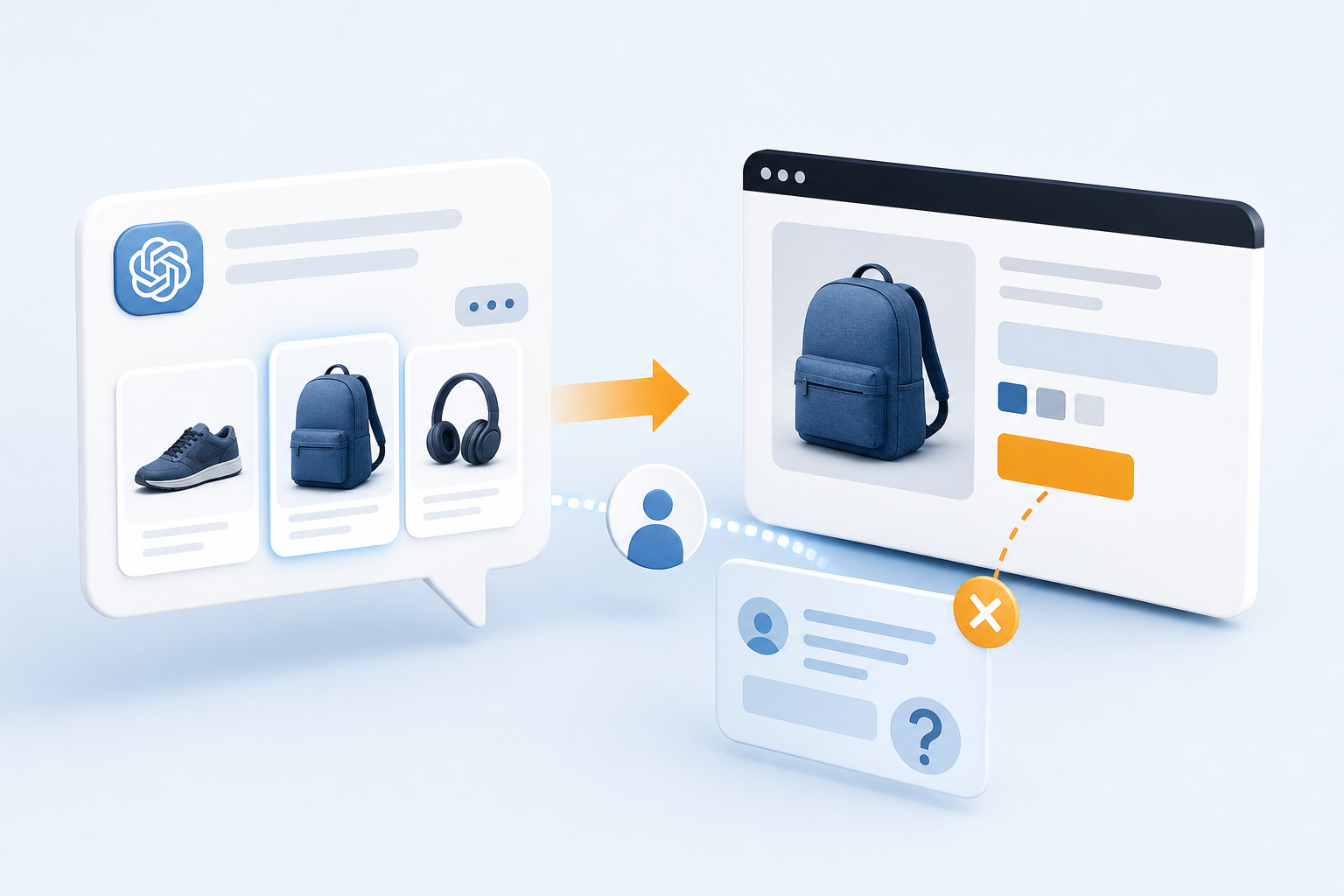
In 2026, Shopify and OpenAI deepened their connection, allowing ChatGPT to surface Shopify product listings directly inside chat responses. A shopper asks ChatGPT for a recommendation and, instead of a generic answer, sees product cards with images, prices, and links drawn from participating Shopify merchants.
For merchants, this means your products can appear inside ChatGPT conversations without the shopper ever visiting a search engine. That is a meaningful shift in how discovery works.
The mechanism is a structured data handoff. ChatGPT reads product information that Shopify exposes, formats it into a response, and presents it to the shopper. You don't write a prompt. The shopper doesn't ask for your brand by name. The AI decides what fits the query and surfaces it.
This is genuinely useful for top-of-funnel visibility. If your catalog is well-structured and your listings are clear, you have a real chance of appearing in AI-generated recommendations.
Where the Integration Stops
Here is what the integration does not do: it does not change what happens when the shopper clicks through to your site.
The click happens. The sale may not.
A shopper who arrived via ChatGPT has already had a conversation. They asked a question, received a recommendation, and followed it. They arrive on your product page with context, intent, and often a specific comparison or fit question still in their head. Your static product page cannot continue that conversation. It shows the same content it shows every visitor, regardless of how they arrived or what they were just told.
This is the gap the Shopify-ChatGPT integration does not address. It improves the referral. It does not improve the reception.
Adobe Analytics data from 2026 shows AI-driven referrals to retail sites have grown substantially year over year. More shoppers are arriving via AI assistants. But arriving is not converting. The problem is structural: the pages these shoppers land on were built for a different kind of visitor, one who browsed their way to a product rather than one who was sent there mid-conversation.
For a closer look at how AI-referred visitors behave once they land, the data on ChatGPT visitor conversion patterns is worth reading before you assume the integration alone will move your numbers.
What Your Shopify Store Was Built For
Your Shopify store was built for a visitor who browses. Navigation menus, collection pages, filters, related product carousels: all of that infrastructure assumes a shopper who is exploring. It works well for that visitor.
An AI-referred visitor does not browse. They arrive with a specific question already formed. They want to know whether the product ChatGPT mentioned actually fits their situation. They want to ask a follow-up. They want something to continue the conversation the AI already started.
A static product page cannot do that. It can display information, but it cannot respond to a question it has never seen.
This is not a Shopify limitation specifically. It is a structural property of any static page. The page was written once and answers the questions its author anticipated. An AI-referred shopper often arrives with a question the author did not anticipate, because the AI assistant framed the product in a way the merchant never wrote.
The Gap Between Citation and Conversion
The integration makes citation easier. It does not make conversion automatic.
Consider what actually happens in that gap. A shopper asks ChatGPT: "What's a good collagen supplement for someone who runs every day and has trouble with joint recovery?" ChatGPT recommends a product from your catalog. The shopper clicks. They land on a product page that describes ingredients, dosage, and reviews. Nowhere does it specifically address joint recovery for runners. The shopper has a follow-up question. There is no one to ask. They leave.
The click happened. The sale did not.
This pattern repeats across categories. Skincare shoppers asking about ingredients for sensitive skin. Apparel shoppers asking about fit for specific body types. Home goods shoppers asking whether a product works in a particular space. These are not edge cases. They are the normal behavior of a high-intent shopper who arrived from an AI assistant.
The integration increases the volume of these visitors. It does not solve the problem of what to do with them once they arrive.
What Solving This Actually Requires
Continuing the conversation an AI assistant started requires a different kind of page. Not a better product description. Not more reviews. A page that can hold a natural language exchange with a shopper, answer questions it was never explicitly programmed to answer, and guide that shopper toward a decision.
That is not a chatbot widget bolted onto an existing page. A widget sits on top of a static page and handles a narrow set of scripted queries. What AI-referred shoppers need is a surface built from the start to handle open-ended questions about your specific products.
Building that on your existing Shopify store is difficult without significant development work. You would need to modify your storefront, integrate a conversational layer, connect it to your product data, and maintain it as your catalog changes. For a team of two to fifteen people running a DTC brand, that is not a realistic project.
There is a different approach: a parallel site that sits alongside your existing store, lives on your own subdomain (ai.yourbrand.com), and handles AI-referred visitors without touching your existing Shopify setup. How that parallel layer fits into a Shopify or headless stack is worth understanding before you commit to any architecture decision.
What You Actually Need to Know About Your Store Right Now
Before deciding how to respond to the Shopify-ChatGPT integration, you need to know what questions AI-referred visitors are already asking that your current pages cannot answer. Most merchants don't know this. They know their traffic sources at a category level, but not the specific questions arriving from ChatGPT, Gemini, Perplexity, or Claude that their pages fail to address.
That gap analysis is the starting point. Without it, you're making infrastructure decisions without knowing what problem you're solving.
Aigency's free site scan surfaces exactly this: the specific questions AI-referred visitors are asking that your existing pages cannot answer. It produces a personalized gap report, not a generic audit. You see the actual queries, mapped to the pages that fail to answer them. That is the input you need before deciding whether and how to build a conversational layer.
The scan requires no code integration and no developer involvement. It reads your rendered site the same way a human visitor would, using vision-based crawling agents, and produces a report specific to your catalog and your AI-referred traffic patterns.
The Broader Picture for Shopify Merchants in 2026
The Shopify-ChatGPT integration is one piece of a larger shift. ChatGPT is not the only AI assistant sending traffic to retail sites. Gemini, Perplexity, Claude, and Copilot all refer shoppers to product pages. The Shopify integration makes ChatGPT referrals more structured and more visible, but it does not address the full scope of AI-referred traffic or the conversion problem that applies across all of these sources.
Merchants who treat the integration as a complete solution will see more clicks and flat conversion. Merchants who treat it as the top of a funnel that needs a different kind of bottom will be better positioned.
The question is not whether to participate in the Shopify-ChatGPT integration. You should. The question is what you build behind it.
For merchants thinking about what that infrastructure looks like without a full rebuild, converting AI search visitors without rebuilding your Shopify store covers the practical options in 2026.
The Shopify Store Is Not Going Away
One thing worth stating directly: nothing about AI-referred traffic, the ChatGPT integration, or agentic commerce infrastructure means your existing Shopify store needs to be replaced. It does not.
Your Shopify store handles transactions, inventory, and the checkout flow your existing customers already trust. A parallel conversational layer does not replace any of that. It handles the visitors who need a conversation before they're ready to transact, then hands them off to your existing checkout.
This is not a replatforming decision. It is an addition. The merchants who will struggle are the ones who treat it as either/or: keep the static store as-is, or rebuild everything for AI. Neither extreme is right.
The practical path is a parallel layer that handles AI-referred visitors specifically, runs on your own subdomain, and connects to your existing checkout without requiring your development team to touch the core store.
For teams evaluating whether headless infrastructure or an agentic layer makes more sense for their situation, the comparison of headless commerce versus agentic infrastructure in 2026 is a useful frame before making any architecture commitment.
What to Do With This Information
The Shopify-ChatGPT integration is worth taking seriously. It represents a real change in how shoppers discover products. It also represents an increase in a specific kind of visitor your current store was not built to serve.
The integration improves the referral. What you build behind it determines whether the referral converts.
Start with the gap analysis. Know what questions your AI-referred visitors are already asking. Then decide what to build.
Aigency's free site scan gives you that picture without any developer involvement. Visit aigency.ai to run the scan on your store and see exactly where the gap is.
Frequently Asked Questions
What does the Shopify ChatGPT integration actually do for merchants?
It allows ChatGPT to surface Shopify product listings inside chat responses when a shopper asks for a recommendation. Your products can appear in AI-generated answers without the shopper visiting a search engine first. It improves discoverability at the top of the funnel but does not change what happens after the shopper clicks through to your site.
Do I need to do anything to participate in the Shopify-ChatGPT integration?
The integration works through structured product data that Shopify exposes. Well-structured, complete product listings improve your chances of appearing in ChatGPT recommendations. There is no separate application or activation required for most Shopify merchants, but keeping your product data clean and descriptive is the practical lever you control.
Why do AI-referred visitors behave differently from other shoppers?
A shopper arriving from ChatGPT or another AI assistant has already had a conversation. They received a specific recommendation and followed it. They arrive with a question already formed, often a comparison or fit question, and they expect to continue that conversation on your site. A static product page cannot respond to a question it was not written to answer, which is why AI-referred visitors often leave without converting even when their intent is high.
Does the Shopify-ChatGPT integration solve the conversion problem?
No. The integration improves the volume and structure of AI referrals to your store. It does not change what happens when the shopper lands on a static product page. The conversion gap between AI-referred visitors and purchase is a separate problem that requires a conversational layer, not just better product listings.
What is a parallel agentic site and how is it different from a chatbot widget?
A parallel agentic site is a separate site hosted on your own subdomain (ai.yourbrand.com), built specifically to hold natural language conversations with shoppers about your products. It is not a widget sitting on top of your existing pages. It handles open-ended questions, answers product queries, and guides shoppers to your existing checkout. Your main Shopify store remains unchanged.
How do I find out what questions AI-referred visitors are asking my store right now?
Aigency offers a free site scan that produces a gap report showing the specific questions AI-referred visitors are asking that your existing pages cannot answer. It requires no code integration and reads your rendered site using vision-based crawling agents. The output is specific to your catalog and your actual AI-referred traffic, not a generic audit.
Does adding a conversational layer mean rebuilding my Shopify store?
No. A parallel agentic layer sits alongside your existing store on a separate subdomain and handles AI-referred visitors specifically. Your Shopify store handles transactions, inventory, and checkout exactly as it does today. The parallel site hands shoppers off to your existing checkout once they are ready to buy. It is an addition, not a replacement.
https://aigency.ai/blog/shopify-chatgpt-integration-merchants-2026