Playbook · · 8 min read
Why Your Product Feed, Not Your Page Content, Decides Whether You Rank High on ChatGPT
By Itamar Weisbrod
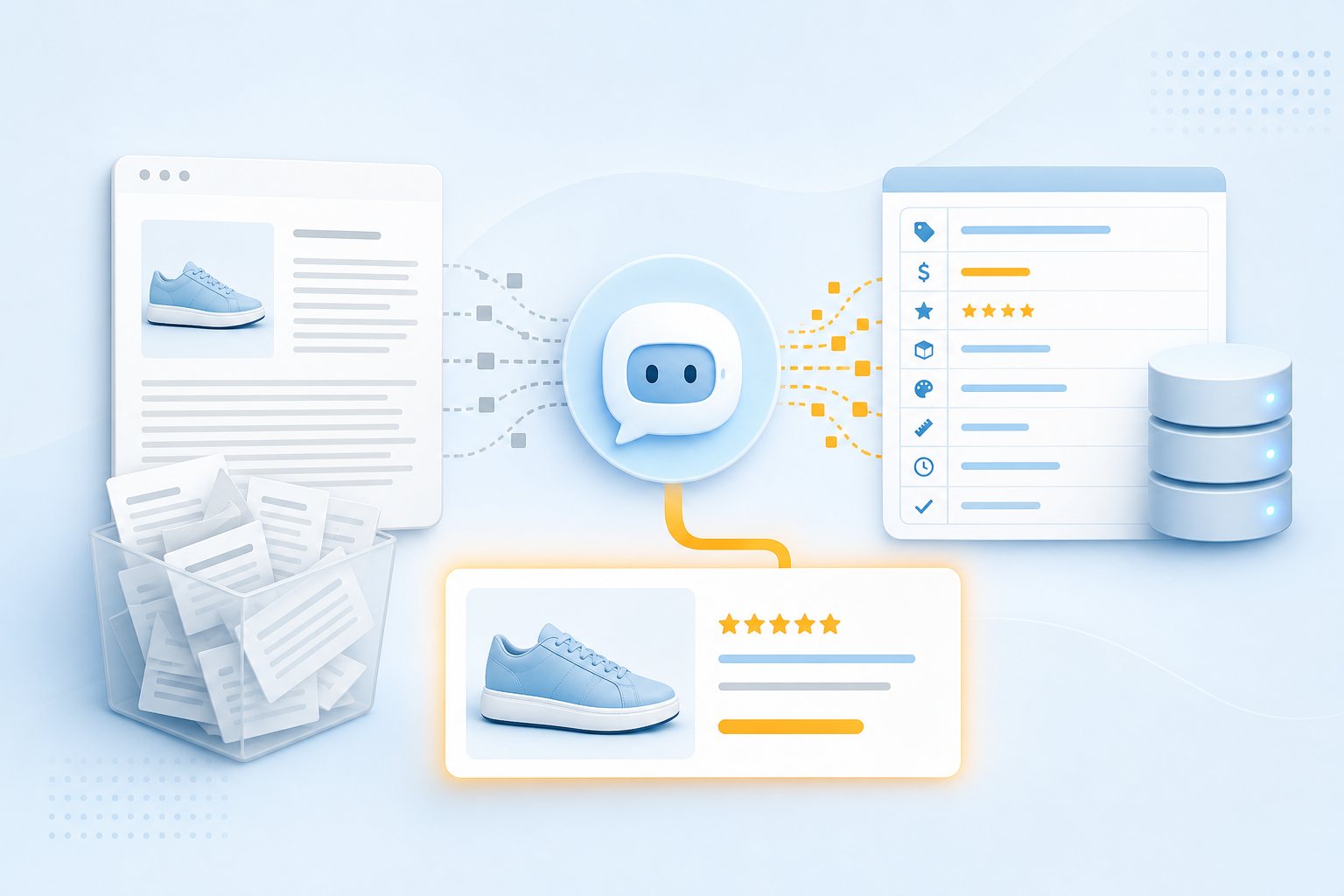
If you want to rank your ecommerce store high on ChatGPT in 2026, the most important file on your server is probably one you haven't touched in months: your product feed.
Most ecommerce SEO advice circles around page content, schema markup, and earning citations from authoritative publishers. That work still matters. But there's a separate layer -- one that's becoming increasingly decisive -- that determines whether ChatGPT, Perplexity, Gemini, and similar AI assistants quote your products directly inside their responses: the structured data you export about your catalog.
This piece covers why the product feed has become the primary lever for AI visibility, what a feed actually needs to look like for AI engines to use it, and where most Shopify and ecommerce feeds fall short right now.
The Shift from "Getting Clicked" to "Getting Quoted"
Traditional search optimization was about earning a click. You ranked, the user clicked, and your page did the rest. AI assistants work differently. They synthesize an answer and surface specific products, prices, and attributes inside that answer -- often without the user clicking anywhere at all.
That changes the question you need to be asking. It's no longer "does my page rank?" It's "does my product data get quoted?"
Research published by IWD Agency in 2026 found that AI engines are increasingly citing structured product feeds directly -- not just on-page content -- when generating shopping recommendations. Ranketta's 2026 analysis of AI-generated product mentions reached a similar conclusion: the stores appearing most consistently in AI shopping responses had cleaner, more complete structured data exports, not necessarily the best-written product pages.
The implication is significant. You can have excellent copy, a well-structured product detail page, and solid review content, and still be invisible in AI responses if your feed is incomplete, stale, or formatted in a way that makes machine parsing unreliable.
What AI Engines Actually Need from a Product Feed
AI assistants aren't reading your product pages the way a human does. They're ingesting structured data and using it to answer specific, often comparison-style queries: "What's the best waterproof hiking boot under $200?" or "Which protein powder has the highest leucine content per serving?"
To answer those questions accurately, an AI engine needs more than a product name and a price.
Complete, Granular Attributes
A feed that says "Color: Blue" is less useful than one that says "Color: Navy, Material: 100% cotton, Weight: 180gsm, Fit: Relaxed." AI assistants are answering attribute-specific questions. If your feed doesn't contain the attribute, your product can't be cited in the answer.
Most Shopify stores export a standard Google Shopping feed. That format covers the basics, but it was designed for paid ads -- not for AI comprehension. Fields like material composition, use case, compatibility, or nutritional data are often missing entirely, or collapsed into a single description string that's harder to parse reliably.
Accurate, Real-Time Pricing and Availability
AI engines surfacing product recommendations are increasingly sensitive to data freshness. A product cited as "in stock at $89" that's actually out of stock or now priced at $109 creates a bad experience -- and some AI assistants are beginning to factor data recency into how confidently they cite a source.
Many ecommerce feeds update once every 24 hours. For stores with frequent inventory changes or dynamic pricing, that lag is a real liability.
Structured Review Data
Review signals help AI assistants calibrate confidence in a recommendation. A product with 4.7 stars across 2,300 reviews is a much safer citation than one with no review data attached. If your feed doesn't include aggregate review scores and review counts as structured fields, that signal is invisible to the AI engine -- even if the reviews are right there on your page.
Machine-Readable Format
XML and JSON are both usable, but the structure within the file matters as much as the format itself. Inconsistent field naming, values crammed into description fields, missing required attributes, and non-standard category taxonomies all reduce the reliability of machine parsing.
Google's product data specification is a reasonable baseline, but AI engines aren't Google. They may weight fields differently, parse descriptions with varying accuracy, and handle edge cases in ways that aren't fully documented. The safest approach is to treat your feed as a structured database, not a formatted document.
Where Most Ecommerce Feeds Fall Short
The gap between what AI engines need and what most stores currently export is wide. A few patterns come up repeatedly:
Attributes buried in descriptions. Many stores put everything in the product description field because their feed template doesn't have a dedicated attribute column. A sentence like "Available in navy, forest green, and burgundy, made from 100% organic cotton" is readable to a human but much harder for a machine to extract reliably compared to discrete color and material fields.
Stale data. Feeds generated from a nightly export miss intraday inventory changes. For stores running flash sales or managing tight stock levels, this creates a mismatch between what AI assistants cite and what actually exists when a shopper arrives.
Missing review fields. Review aggregation is often handled by a third-party app that doesn't write back to the feed. The data exists in the store -- it's just not in the export.
Flat category taxonomy. A product categorized only as "Footwear > Boots" gives an AI engine far less to work with than "Footwear > Hiking Boots > Waterproof > Men's > Mid-Cut." The more specific the taxonomy, the more query types your product can match.
No use-case or compatibility data. For technical products, accessories, or anything with compatibility requirements, this is often the field AI assistants need most. It's also the one most commonly absent from standard feed templates.
The Feed Is Infrastructure, Not Content
This is the distinction worth holding onto. Page content is something your marketing team controls and iterates on. Your product feed is infrastructure -- and it behaves like infrastructure: invisible when it works, expensive when it doesn't.
Fixing a feed isn't a content project. It requires changes to how your catalog data is structured, how attributes are mapped, how frequently the export runs, and how review and inventory data flows into the output. On Shopify, BigCommerce, Salesforce Commerce Cloud, or Magento, the path to a clean feed looks different depending on your catalog complexity and how your data is stored.
The stores that will appear most consistently in AI shopping responses over the next 12 to 18 months are the ones treating their feed as a first-class data product -- not an afterthought generated from whatever the platform exports by default.
Where Aigency Fits
The feed problem is one layer of a larger infrastructure gap. AI-referred shoppers who do arrive at your site -- whether they clicked a link in a ChatGPT response or were sent by an autonomous agent -- land on static pages that weren't built to continue the conversation the AI assistant started.
Aigency addresses this at the infrastructure layer. It builds a parallel, agentic version of your site on your own subdomain, ai.yourbrand.com, that can hold a natural language conversation with shoppers, answer the specific questions AI assistants primed them to ask, and guide them to checkout. It also scans your existing site to surface the questions AI-referred visitors are asking that your current pages can't answer -- which often reveals the same attribute gaps that make your feed hard for AI engines to cite in the first place.
The feed and the landing experience are two sides of the same problem. Getting cited in an AI response and then converting that visitor are both infrastructure questions, not content questions.
Frequently Asked Questions
Does improving my product feed actually affect whether ChatGPT mentions my products?
Based on 2026 research from IWD Agency and Ranketta, structured product data is increasingly a direct input into AI-generated shopping recommendations. A more complete, accurate feed gives AI engines more to work with when matching products to queries. Feed quality is one factor among several, and results will vary by category and query type.
My store is on Shopify. What does my default feed look like to an AI engine?
Shopify's default Google Shopping feed covers the core fields required for paid ads, but it typically lacks granular attributes, use-case data, compatibility fields, and structured review data. It's a starting point, not an optimized AI-readable export.
How often should my product feed update for AI visibility?
Daily updates are the current norm, but for stores with frequent inventory changes or dynamic pricing, more frequent exports reduce the risk of AI assistants citing stale information. Intraday updates are worth considering if stock levels or prices shift significantly within a single day.
What is the difference between product feed optimization and on-page schema markup?
On-page schema markup is embedded in your HTML and is read when a crawler visits your page. Your product feed is a separate export file that AI engines and shopping platforms ingest directly. Both matter, but they serve different ingestion paths -- improving one doesn't automatically improve the other.
Do review scores need to be in the feed, or is it enough that they appear on the page?
For AI engines ingesting your feed directly, review data needs to be in the feed as structured fields. Review content on the page may be read by crawlers separately, but it isn't reliably connected to the feed record unless you explicitly include it.
What fields matter most for AI visibility in 2026?
The highest-impact additions for most stores are granular product attributes (material, dimensions, compatibility, use case), accurate availability status, aggregate review score and count, and a specific category taxonomy. These are the fields most commonly missing from standard exports and most useful for answering the comparison and attribute-specific queries AI assistants handle.
Is this only relevant for stores with large catalogs?
No. A small catalog with complete, accurate, well-structured data will outperform a large catalog with incomplete or inconsistently formatted records. Feed quality matters more than catalog size when it comes to AI citation.
The shift from page-level optimization to feed-level optimization is real, and it's already affecting which ecommerce brands appear in AI shopping responses. Audit your feed before you audit your pages. Start at aigency.ai to see where your current setup stands.
https://aigency.ai/blog/product-feed-ai-ranking-chatgpt-2026