Playbook · · 7 min read
What Gemini Shopping Means for Product Discovery and Why Merchants Cannot Ignore It
By Itamar Weisbrod
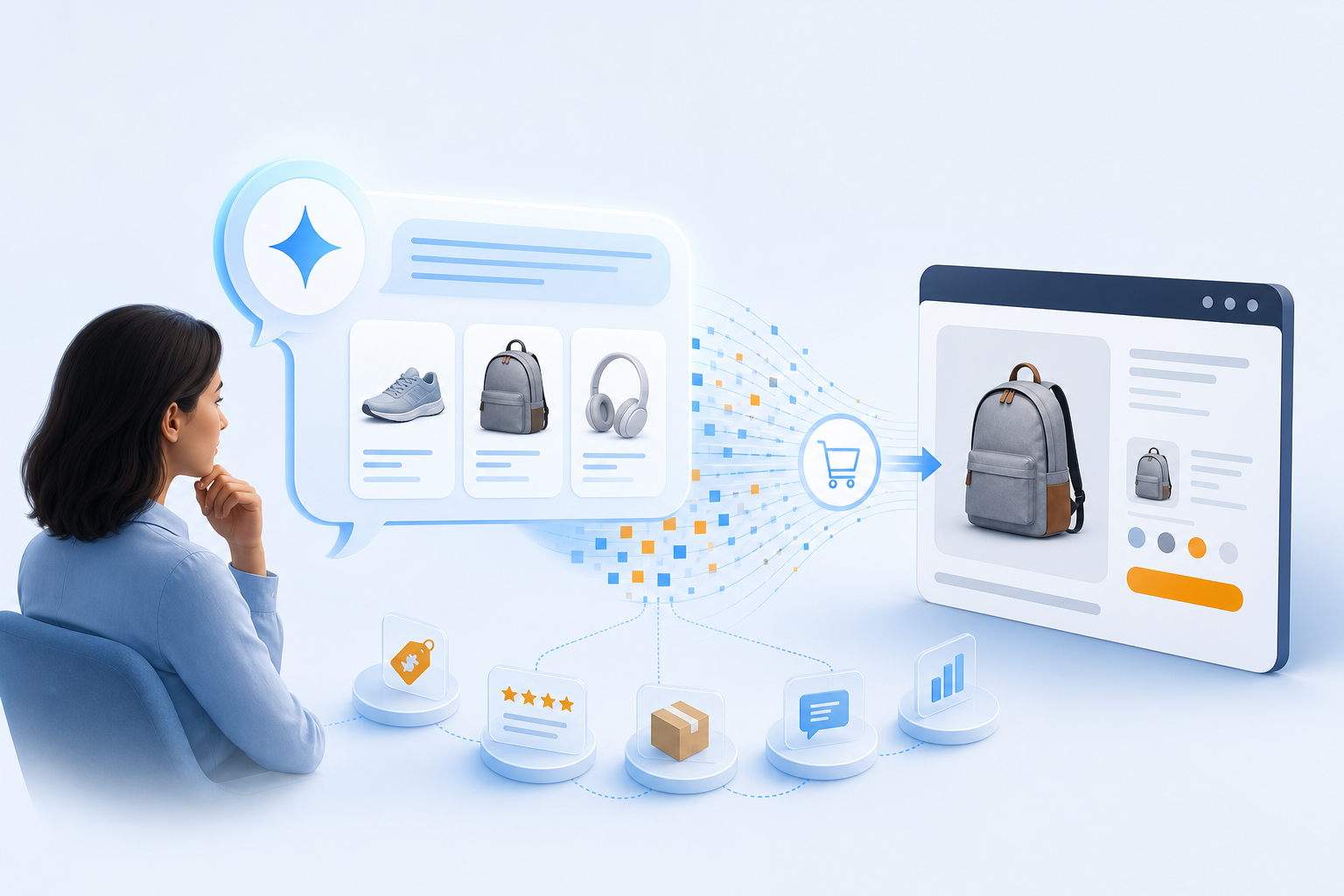
Google's Gemini is not just a chatbot sitting alongside search results. In 2026, it is increasingly the first place shoppers describe what they want and receive a specific product recommendation in return. If your brand shows up in that recommendation, a high-intent visitor arrives at your site. If your site cannot continue the conversation Gemini already started, that visitor leaves.
That gap is what this article is about.
How Gemini Shopping Actually Works
Gemini processes natural language queries and returns product recommendations with reasoning attached. A shopper does not type "retinol serum" into a search bar. They ask something like: "What retinol serum should I use if I have sensitive skin and haven't used retinol before?" Gemini reads that context, evaluates products across the web, and returns a short list with explanations.
The referral that follows is qualitatively different from a standard organic click. The shopper already received a recommendation. They already read a rationale. By the time they land on your product page, they are not browsing. They are confirming.
That is what makes Gemini shopping referrals worth paying attention to. The intent is further along the purchase funnel than almost any other traffic source.
What Gemini Reads When It Evaluates Your Products
Gemini does not evaluate your products the way a human shopper does. It reads structured and unstructured data: product titles, descriptions, ingredient lists, reviews, FAQ content, schema markup, and editorial content that discusses your products in context.
The questions shoppers ask Gemini tend to be comparison-heavy and guidance-seeking. "Is this safe for X?" "How does this compare to Y?" "What size should I order if I'm between sizes?" These are not questions your product page title answers. They require depth that most static product pages do not have.
If Gemini cannot find a clear answer in your content, it either omits your product from the recommendation or qualifies its mention with uncertainty. Neither outcome helps your brand.
The Arrival Problem
Here is what actually happens when Gemini refers a shopper to your site.
They arrive having already had a detailed, contextual conversation with an AI assistant. They have a specific question or confirmation they are looking for. Your product page shows them a title, a price, some images, and a description written for keyword density rather than conversational guidance.
The click happened. The sale did not.
This is the structural mismatch at the center of the Gemini shopping problem. The traffic source is conversational. The landing experience is static. No amount of SEO optimization on your existing pages closes that gap, because the gap is architectural, not editorial.
AI-referred visitors behave differently from organic search visitors, and the data reflects it. They arrive with higher intent and more specific questions. When those questions go unanswered, they do not browse deeper. They leave.
Why Product Discovery Is Shifting Toward AI Assistants
Gemini is one of several AI assistants now actively participating in product discovery. ChatGPT, Perplexity, Claude, and Copilot all surface product recommendations in response to natural language queries. Gemini's integration with Google's broader ecosystem gives it particular reach, especially on Android devices and within Google's own surfaces.
Adobe Analytics has tracked the growth of AI-referred traffic to retail sites, and the trajectory is consistent: referrals from AI assistants have grown substantially year over year. The pattern is not limited to one assistant or one product category. It is showing up across skincare, supplements, apparel, and home goods, anywhere shoppers benefit from guidance before they buy.
The merchants seeing this traffic in their analytics today are early. The ones who build for it now will have a structural advantage when it becomes the norm.
What Your Existing Site Cannot Do
A static product page cannot ask a follow-up question. It cannot say "you mentioned sensitive skin, so here is why this formulation works for that." It cannot compare two products in your catalog based on the shopper's stated situation. It cannot pick up where Gemini left off.
This is not a criticism of your site. It was built for search engines and human browsers, and it does that job well. The problem is that Gemini-referred shoppers arrive with expectations shaped by a conversational interface. They expect the destination to match the experience they just had.
Most do not get that. They get a product page.
Building an Arrival Experience That Matches the Referral
The solution is not to rebuild your storefront. It is to deploy a parallel layer that handles the conversational part of the journey without touching your existing infrastructure.
Aigency builds a parallel, agentic version of your site hosted on your own subdomain (ai.yourbrand.com). Vision-based crawling agents read your existing site exactly as a visitor would, without requiring code integration, database access, or developer involvement. The result is a site that can hold a natural language conversation with shoppers, answer the specific questions Gemini-referred visitors are asking, and guide them toward checkout on your existing storefront.
This is not a chatbot widget added to your existing pages. It is a separate hosted experience designed specifically for visitors who arrive expecting to continue a conversation.
If you are already on Shopify or a comparable platform, the integration question is simpler than it sounds. The parallel site sits alongside your existing stack and handles the conversational layer. Checkout remains where it always was.
Finding the Questions You Are Currently Failing to Answer
For most operators, the starting point is not building the parallel site. It is understanding what questions Gemini-referred visitors are actually asking that your current pages cannot answer.
Aigency's free site scan surfaces exactly that. It identifies the specific questions AI assistants are sending to your site that your existing content does not address. The output is specific to your brand, your product catalog, and the queries your site is already receiving from AI referrals.
That is the evidence you need before making any infrastructure decision. If the scan surfaces a handful of unanswered questions, you know where the leakage is. If it surfaces dozens, you understand the scale of the problem.
The Ongoing Maintenance Question
One objection that comes up often: what happens when your product catalog changes? New SKUs, updated formulations, seasonal inventory shifts. If the parallel site is a snapshot, it goes stale.
Aigency's Monitoring Agent addresses this directly. It watches your main site and automatically updates the parallel site when content changes. You do not manage the sync manually. The parallel site stays current without additional work from your team.
This matters because Gemini's recommendations are based on what it can read about your products right now. Stale content on your agentic layer means stale answers to shopper questions, which undermines the entire purpose of having the layer in the first place.
A Note on Brand Safety
When you deploy a conversational layer, you are putting language in front of shoppers under your brand name. That requires guardrails.
Aigency's Policy and Control Agent lets you define what the parallel site may say, what it must never say, and where it directs shoppers. If there are claims you cannot make for regulatory reasons, or topics you want to route to a human, those rules are set by you and enforced by the agent.
For brands in regulated categories (supplements, skincare with active ingredients, health-adjacent products), this is not optional. It is the difference between a conversational layer that helps and one that creates liability. If your site operates in a jurisdiction with specific digital compliance requirements, tools like Euraika Aegis provide automated monitoring to help ensure your web presence meets applicable legal standards alongside your content guardrails.
What to Do With This Information
If you are seeing AI-referred traffic in your analytics and your conversion rate on that segment is lower than your site average, the arrival problem is already affecting your revenue. The intent was there. The page was not.
Understanding how an agentic layer fits your existing stack is the practical next step. It does not require a replatform, a development sprint, or a new infrastructure budget. It requires understanding what questions your AI-referred visitors are asking and whether your current pages answer them.
The free site scan at aigency.ai gives you that answer for your specific site. Start there.
FAQs
What is Gemini shopping and how does it differ from Google Shopping?
Gemini shopping refers to product discovery that happens through Google's Gemini AI assistant, where shoppers describe what they need in natural language and receive specific product recommendations with explanations. Traditional Google Shopping surfaces products based on keyword bids and product feed data. Gemini evaluates products based on how well the available content answers the shopper's specific question, which means the ranking factors and the referral intent are both different.
Why do Gemini-referred visitors behave differently from organic search visitors?
Shoppers referred by Gemini have already received a recommendation and a rationale before they arrive at your site. They are not browsing. They are confirming a decision or looking for a specific answer. That means they have higher purchase intent but also higher expectations for the landing experience. A static product page that cannot answer their follow-up questions creates friction at exactly the wrong moment.
What does Gemini read when deciding whether to recommend a product?
Gemini processes product titles, descriptions, ingredient or specification details, review content, FAQ sections, schema markup, and editorial content that discusses your products in context. It is particularly responsive to content that directly answers the kinds of guidance-seeking questions shoppers ask, such as comparisons, suitability for specific conditions, and sizing or usage guidance.
Do I need to rebuild my existing site to capture Gemini shopping traffic?
No. Aigency builds a parallel site on your own subdomain (ai.yourbrand.com) that handles the conversational layer for AI-referred visitors. Your existing storefront stays in place. Checkout remains on your current site. The parallel site is a separate hosted layer that picks up where the AI assistant left off, without requiring code integration or developer involvement.
How do I know if Gemini-referred visitors are already arriving at my site?
Check your analytics for referral traffic from Google's AI surfaces or direct Gemini referrals. In GA4, AI-referred sessions may appear under specific referral sources or as direct traffic with unusually high intent signals. Aigency's free site scan goes further: it identifies the specific questions AI assistants are sending to your site that your existing pages are not answering, giving you a concrete picture of where conversion is leaking.
What happens when my product catalog changes after I deploy a conversational layer?
Aigency's Monitoring Agent watches your main site and automatically updates the parallel site when content changes. New products, updated descriptions, and pricing changes are reflected without manual intervention. This keeps the conversational layer accurate and prevents shoppers from receiving outdated information.
Is a conversational layer safe for brands in regulated categories like supplements or skincare?
Yes, with proper guardrails in place. Aigency's Policy and Control Agent lets you define exactly what the parallel site may and may not say, which topics it routes elsewhere, and where it directs shoppers. For brands where specific claims are restricted by regulation, these controls are essential before deploying any conversational experience under your brand name.
https://aigency.ai/blog/gemini-shopping-product-discovery-merchants