Playbook · · 7 min read
Why Your Product Page Answers Zero AI Shopping Questions (And the Fix Takes One Afternoon)
By Itamar Weisbrod
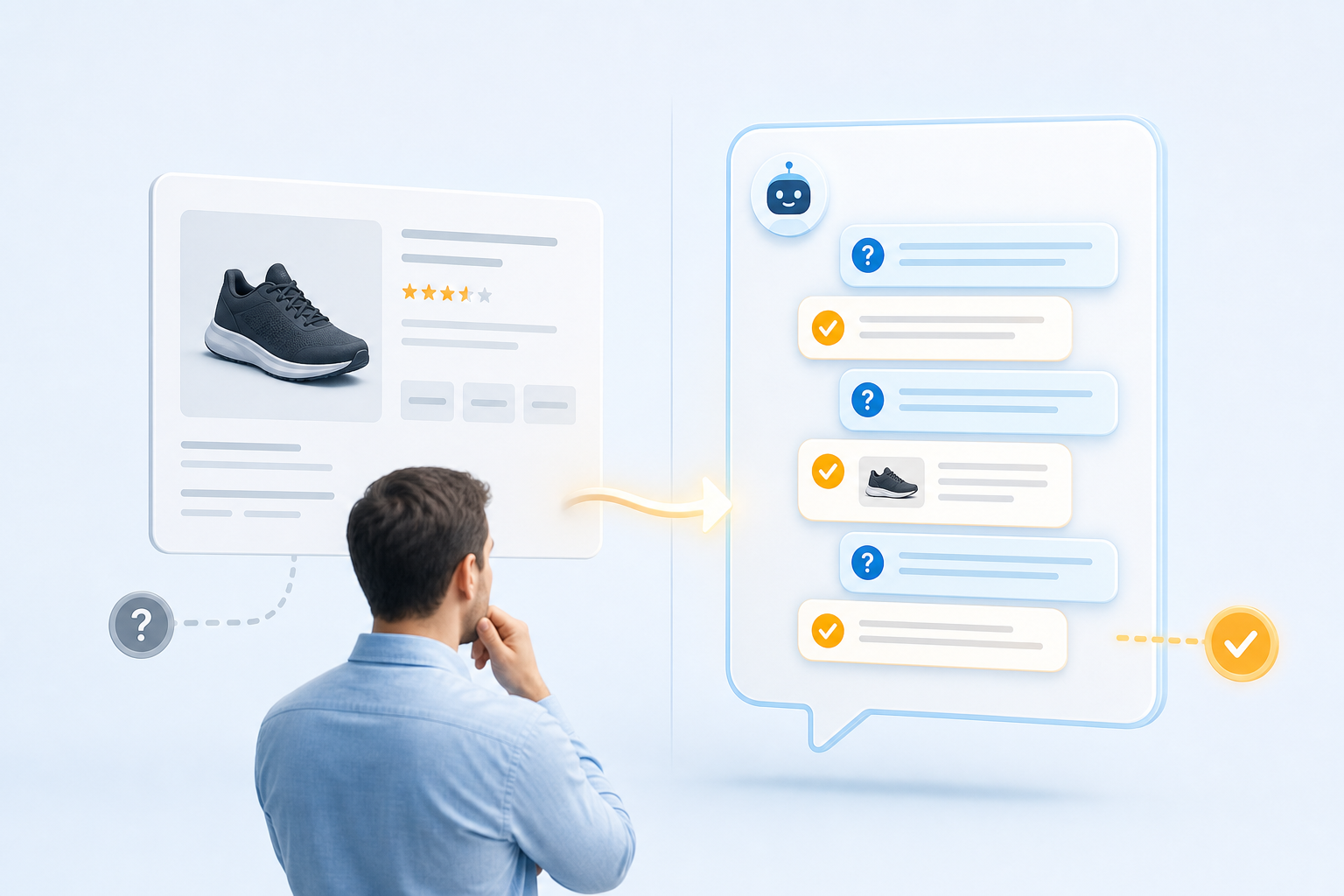
A shopper asks ChatGPT which retinol serum is safe for sensitive skin. ChatGPT names your brand. The shopper clicks through, lands on your product page, and reads: "Clinically tested. Dermatologist approved. 1 fl oz."
The click happened. The sale did not.
This is not a design problem or a copy problem. It is a structural one. The conversation that qualified this shopper happened inside an AI assistant, and your static product page was never built to continue it.
What AI-Referred Shoppers Actually Want
When a shopper arrives from ChatGPT, Gemini, Claude, or Perplexity, they are not starting their research. They are finishing it. The AI assistant already answered the broad question. Now the shopper wants confirmation on the specific one.
"Does this work if I also use a vitamin C serum in the morning?"
"What size should I order if I'm between a medium and a large?"
"Is this supplement third-party tested, and for what?"
None of these questions appear in your product description. They never did, because your product page was written for a different shopper: one who arrived from a Google search result or a paid ad and needed to be sold on the category before they could be sold on the product.
AI-referred shoppers skip that stage entirely. They arrive pre-convinced. What they need is a conversation, and your static page cannot have one.
Why Static Pages Fail This Traffic
Adobe Analytics reported that AI-driven referrals to retail sites in the United States grew roughly 1,200 percent between July 2024 and February 2026. That growth is not slowing. The channel is real, the traffic is real, and the gap between what these shoppers need and what a standard product page delivers is widening every month.
The structural problem is this: a static product page is a broadcast. It says the same thing to every visitor, in the same order, regardless of what that visitor already knows or what question brought them there. For AI-referred shoppers, that broadcast almost always misses.
Visibility Labs analyzed 94 ecommerce brands over 12 months of GA4 data and found that AI-referred visitors show meaningfully different engagement patterns than organic search visitors. They arrive with higher intent and lower patience for irrelevant content. A page that does not immediately address the question they arrived with loses them fast.
Your page was not designed for this. That is not a criticism. It was designed for a traffic pattern that is now being supplemented by a fundamentally different one.
The Questions Your Pages Are Not Answering
Here is what actually happens when an AI assistant refers a shopper to your brand. The assistant has already synthesized information about your product from multiple sources: your site, review platforms, editorial coverage, community discussions. It has formed an opinion. The shopper trusts that opinion enough to click.
But the assistant's answer was general. The shopper's follow-up question is specific. And the moment they land on your site, there is no one to ask.
The questions that go unanswered tend to cluster into a few categories.
Comparison questions. "How does this compare to the other option the AI mentioned?" Your product page does not compare itself to anything, because that would have been considered bad form in traditional SEO copy.
Fit and compatibility questions. "Will this work with my existing routine, setup, or situation?" These require context the page does not have about the shopper.
Verification questions. "Is what the AI said about this actually true?" Shoppers arriving from AI assistants sometimes want to confirm a specific claim the assistant made. If that claim is not on your page, doubt sets in.
Edge case questions. "I have a specific constraint. Does this still apply to me?" These are the questions most product pages never address because they seem too niche to warrant copy space.
The gap between what shoppers are asking and what your pages contain is measurable. Aigency's free site scan surfaces exactly this: the specific questions AI-referred visitors are asking that your existing pages do not answer. It is worth running before you do anything else, because the results tend to be surprising.
Why You Cannot Copy-Edit Your Way Out of This
The instinct, when you see this gap, is to write more. Add an FAQ section. Expand the product description. Build a comparison table.
That work matters. But it does not solve the underlying problem.
You do not know which questions are being asked until after the shopper has already left. And even if you did know, you cannot write a static page that answers every possible follow-up without turning your product page into a wall of text that converts no one.
There is also a freshness problem. Your product page reflects what you knew about your shoppers when you wrote it. AI-referred shoppers are asking questions shaped by what AI assistants are saying about your category right now, and that changes. A static page cannot keep up with a moving conversation.
What these shoppers need is not more content. They need a response: one that is specific to their question, in the moment they ask it.
What an Agentic Layer Actually Does
This is where the architecture matters, and it is worth explaining precisely because the category is full of solutions that address adjacent problems without solving this one.
A chatbot widget on your existing product page is not the answer. It sits on top of a static page and fields questions after the shopper has already decided the page is not useful. By that point, many have already left.
An AI-visibility tracker tells you whether your brand is being mentioned in AI assistant responses. That is useful for GEO strategy, but it does not help the shopper who has already clicked through.
What actually addresses the gap is a parallel site: a separate, conversational layer that lives on your own subdomain (ai.yourbrand.com), built specifically to receive AI-referred visitors and continue the conversation the AI assistant started.
Aigency builds exactly this. The platform uses vision-based crawling agents that read your existing site the way a human visitor would, without requiring any code integration, database access, or IT involvement. From that crawl, it generates a site capable of holding natural language conversations with shoppers, answering product questions, and guiding them toward checkout on your existing storefront.
The parallel site is not a replacement for your main site. Checkout stays where it is. Your existing SEO equity is untouched. The agentic layer at ai.yourbrand.com handles the conversation that your static pages were never designed to provide.
For a closer look at how this fits into an existing stack without requiring a replatform, this breakdown of how Aigency fits a Shopify or headless setup covers the architecture in practical terms.
The Afternoon Fix: What You Can Actually Do Today
The phrase "one afternoon" in the title is specific. Here is what that looks like in practice.
Step one: run the free site scan. Aigency's scan reads your existing site and produces a report showing the questions AI-referred visitors are asking that your pages do not answer. This takes minutes to initiate and gives you a concrete, brand-specific picture of the gap. You do not need to guess at what is missing.
Step two: review the gap report. The report is not a list of generic SEO recommendations. It reflects actual questions from actual AI-referred visitors to your category. Some will be obvious once you see them. Others will surprise you. Either way, you now have a prioritized list.
Step three: decide on the response layer. For some operators, the gap report alone is enough to inform a round of content updates. For others, the volume and variety of questions makes it clear that static content cannot scale to meet the need, and a conversational layer on a subdomain is the right answer.
The scan-to-decision process fits in an afternoon. Implementation of the parallel site does not require developer resources or a long onboarding cycle, because the vision-crawl approach means Aigency reads your site without needing access to your codebase or database.
If you are already investing in GEO content to get your brand cited by AI assistants, the conversion layer is the logical next step. Getting cited is one problem. Converting the visitors who arrive because of that citation is a separate one, and it requires a different tool. The article on converting AI search visitors without rebuilding your Shopify store walks through that distinction in detail.
What the Parallel Site Does That Your Product Page Cannot
A few specifics worth naming, because the difference between a parallel agentic site and a standard product page goes beyond conversational tone.
It continues the conversation. When a shopper arrives from ChatGPT having asked about sensitive-skin retinol, the parallel site can address that context directly. It knows the shopper came from an AI assistant. It can meet them where they are.
It handles comparison questions without your product page becoming a comparison chart. The conversational layer can address "how does this compare to X" in a way that is honest and brand-controlled, without requiring you to publish a static comparison table that ages poorly.
It answers edge cases at scale. The questions too specific to warrant a dedicated FAQ entry on your main site are exactly the questions a conversational layer handles well. One shopper's edge case is another shopper's deciding factor.
It stays current automatically. Aigency's Monitoring Agent watches your main site and updates the parallel site when your content changes. You do not manage two sites. The agentic layer reflects your current catalog without manual maintenance.
It operates within guardrails you set. The Policy and Control Agent lets you define what the agent can say, what it must never say, and where it directs shoppers. Brand safety is a configuration, not an afterthought.
For context on how the broader shift toward AI-assisted shopping is changing what shoppers expect when they arrive on site, the data on why ChatGPT-referred visitors convert differently is worth reading alongside this.
The Underlying Shift
Your product pages are not broken. They are optimized for a traffic pattern that is no longer the only one that matters.
The shopper who arrives from a Google search result and needs to be educated about your category is still real. So is the shopper who arrives from a paid ad and needs social proof. Your existing pages serve those shoppers reasonably well.
The shopper who arrives from an AI assistant is different. They have already been educated. They have already received a recommendation. What they need is a response to a specific question, and your static page cannot provide one.
That gap is not going to close on its own. AI assistant referrals are growing as a share of retail traffic. The brands that build a response layer now will have a structural advantage over those that wait until the gap is too large to ignore.
The fix does not require a replatform, a developer, or months of build time. It starts with understanding exactly which questions your pages are failing to answer. That part takes an afternoon.
Start with the free site scan at aigency.ai.
Frequently Asked Questions
What is an AI product page and why does it matter for e-commerce brands?
In the context of this article, an AI product page refers to a conversational, agentic layer designed to receive shoppers referred by AI assistants like ChatGPT, Gemini, or Perplexity. Standard product pages are static broadcasts. They say the same thing to every visitor regardless of what question brought them there. AI-referred shoppers arrive mid-conversation, with a specific follow-up question the static page almost never answers. An agentic page addresses that gap directly.
Why do AI-referred shoppers behave differently from organic search visitors?
AI-referred shoppers have already completed the category research stage inside an AI assistant. They arrive with a specific question or a need for confirmation, not a need to be sold on the product category. Visibility Labs analyzed 94 ecommerce brands over 12 months of GA4 data and found that AI-referred visitors show higher intent and lower tolerance for irrelevant content than organic search visitors. A page that does not immediately address their specific question loses them quickly.
Can I fix this by adding an FAQ section to my existing product pages?
Partially. Adding an FAQ section based on real AI-referred visitor questions is a useful first step and worth doing. The limitation is that you cannot anticipate every question, the questions change as AI assistants update their responses, and a static FAQ cannot respond to the specific context a shopper brings. For operators seeing significant AI-referred traffic, a conversational layer on a subdomain handles the volume and variety of questions more effectively than static content alone.
Does building a parallel agentic site require developer resources or a platform integration?
Not with a vision-crawl approach. Aigency's platform reads your existing site using vision-based crawling agents, the same way a human visitor would, without requiring API access, database credentials, or any code integration. The parallel site is deployed on your own subdomain (ai.yourbrand.com) and does not touch your existing storefront or codebase.
Does the parallel site replace my existing product pages or storefront?
No. The parallel site operates as a separate conversational layer on a subdomain. Your main site, your existing product pages, and your checkout flow remain exactly as they are. The agentic layer handles the conversation that AI-referred shoppers need before they are ready to purchase, then directs them to checkout on your existing storefront.
How do I find out which questions my pages are currently failing to answer?
Aigency offers a free site scan that reads your existing site and surfaces the specific questions AI-referred visitors are asking that your current pages do not answer. It produces a brand-specific gap report rather than generic recommendations. Running the scan is the most direct way to understand the size and shape of the problem for your specific catalog.
Is this only relevant for Shopify brands?
No. The vision-crawl approach means Aigency works with any rendered website: Shopify, headless commerce stacks, BigCommerce, and others, without requiring platform-level integration. The parallel site is deployed independently of whatever commerce platform your main storefront runs on.