Playbook · · 9 min read
The AI Shopping Assistant Landscape in 2026: What Each Platform Recommends and Why
By Itamar Weisbrod
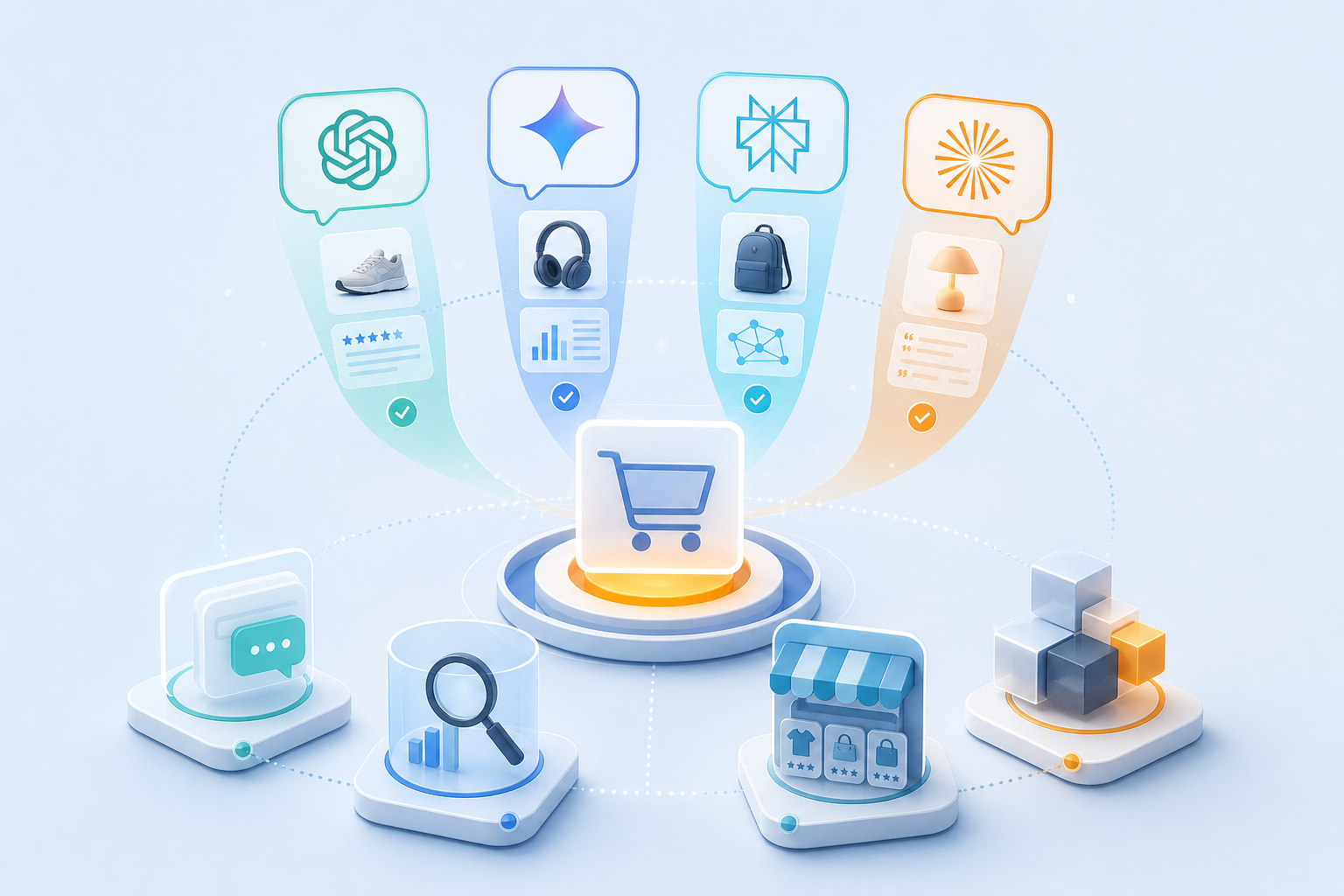
AI shopping assistants are not a single category. The term covers chatbots, visibility trackers, agentic storefronts, and enterprise infrastructure, and each one solves a different problem. If you're trying to figure out which type your store actually needs, start by understanding what each platform is actually built to do.
That distinction matters more now than it did a year ago. Adobe Analytics reported that AI-driven referrals to retail sites grew roughly 1,300 percent year over year in early 2026, and conversion rates for those visitors ran significantly higher than organic search traffic. The traffic is real. The question is whether your storefront is set up to handle it.
This article maps the major categories of AI shopping assistant available to e-commerce operators in 2026, what each one recommends and why, and where the gaps are.
What "AI Shopping Assistant" Actually Means in 2026
The phrase gets applied to products that have almost nothing in common architecturally. Before comparing tools, it's worth separating them into honest categories.
On-site chatbot engagement layers. AI-powered chat widgets that answer product questions, handle objections, and guide shoppers toward a purchase. They work on human visitors who are already on your site. They don't address how visitors arrived or whether the site is readable by autonomous agents.
AI-visibility trackers. Tools that monitor whether your products appear in AI-generated answers from ChatGPT, Perplexity, Gemini, or similar platforms. They tell you what's visible in AI search results and stop there. They build no conversational experience and don't affect what happens after the click.
Agentic storefronts. A newer category. These are infrastructure layers that make your storefront readable and actionable by both AI-referred human shoppers and autonomous AI agents browsing product catalogs without a human in the loop. The better ones also hold natural language conversations with human visitors who arrive mid-intent from an AI assistant.
Enterprise composable commerce backends. Full headless infrastructure stacks built for large organizations with dedicated engineering teams and implementation budgets in the six-figure range. These are not AI shopping assistants in any practical sense for a mid-market brand.
Picking the wrong category means paying for something that doesn't address the actual gap in your funnel. A chatbot engagement layer won't fix the problem of AI-referred visitors bouncing on static product pages. A visibility tracker won't convert anyone. An enterprise backend isn't a realistic option for a 10-person team.
Why the Recommendation Logic Differs by Platform
ChatGPT, Gemini, Claude, and Perplexity each have their own recommendation logic. Understanding how they decide what to surface matters if you want your products to appear.
How ChatGPT Recommends Products
ChatGPT's shopping recommendations draw from a combination of its training data, browsing capabilities when enabled, and structured product data where available. It tends to favor brands with clear, specific product descriptions and content that answers the kinds of questions shoppers actually ask: "Is this moisturizer good for oily skin?" or "What is the difference between these two supplements?"
Static product pages with thin descriptions don't give ChatGPT enough signal. If your product page says "Premium moisturizer, 50ml, $42" and nothing else, ChatGPT has little to work with when a shopper asks a comparison question. The brands that appear consistently in ChatGPT recommendations tend to have invested in content that answers those questions directly, whether through blog posts, detailed PDPs, or structured FAQ content.
How Gemini Approaches Shopping Queries
Gemini integrates with Google's Shopping Graph, which means product availability, pricing, and structured data from Google Merchant Center all feed into its recommendations. For Gemini, technical hygiene matters: schema markup, accurate product feeds, and up-to-date inventory signals all influence whether your products surface.
Gemini also draws on Google Search's broader index, so content quality and topical authority carry weight. A brand that ranks well organically for category terms tends to have an advantage in Gemini's shopping recommendations, though that relationship isn't one-to-one.
How Perplexity Handles Product Discovery
Perplexity is a research-first platform. Shoppers using it for product discovery are typically in a comparison or evaluation mindset, asking questions like "What are the best collagen supplements for joint health?" and reading through cited sources before clicking anything.
Perplexity's recommendations are citation-heavy. It surfaces brands that appear in credible editorial content, reviews, and comparison articles. Pure product pages rarely get cited directly. Brands that invest in answer engine optimization (AEO) and generative engine optimization (GEO) tend to appear more consistently. The click that eventually arrives from Perplexity is high-intent and often mid-conversation, meaning the shopper has already formed a strong opinion before they land on your site.
How Claude Handles Commerce Queries
Claude is less integrated with real-time product data than ChatGPT or Gemini. It draws primarily on its training data and, when given browsing access, on the content it can actually read on your site. If your product pages are JavaScript-heavy and render poorly to a crawler, Claude can't extract useful information from them.
Claude also tends to be more cautious in its recommendations, often framing suggestions as "you might want to look at" rather than direct endorsements. Brands that appear in well-sourced editorial content and maintain clear, readable product pages tend to fare better.
The Gap Most Merchants Are Not Addressing
Here is the structural problem. Each of these AI assistants sends shoppers to your site mid-conversation. The shopper has already asked a question, received an answer, and formed an intent. They arrive expecting to continue that conversation.
Your static product page can't do that.
The click happened. The conversation did not continue.
A Visibility Labs analysis of 94 e-commerce brands over 12 months of GA4 data found that AI-referred visitors showed meaningfully higher purchase intent than visitors from other channels. That intent doesn't automatically convert. It converts when the landing experience matches the conversational context the shopper arrived with.
Most e-commerce storefronts were built for Google traffic and paid social. They're designed around browse behavior, not conversation continuation. A shopper who arrived from ChatGPT after asking "which of these two serums is better for hyperpigmentation" doesn't want to navigate a category page. They want an answer.
That gap is where the category of agentic storefronts exists.
The Platform Categories Worth Knowing
Chatbot Engagement Layers
Chatbot engagement layers add a conversational interface to your existing storefront. They work on human visitors who are already on your site, detecting behavioral signals like exit intent and initiating conversations to recover sessions or answer questions.
These tools are purpose-built for human shoppers. If your primary goal is reducing bounce rate and cart abandonment among visitors who are already browsing, this category does that job well.
What they don't address: the inbound experience for visitors arriving from AI assistants, the readability of your site to autonomous agents, or the gap between the conversation a shopper had with ChatGPT and the static page they land on.
AI-Visibility Trackers
Visibility trackers monitor your brand and product mentions across AI-generated search results. Tools in this category, such as Ranketta, Profound, and similar platforms, tell you whether ChatGPT or Perplexity is mentioning your products when shoppers ask relevant questions.
That data is genuinely useful. Knowing where you appear and where you don't helps you understand the top of the AI search funnel and prioritize your GEO content investments.
The limitation is structural. Visibility trackers have no storefront layer. They can show you that AI search is sending traffic your way, but they can't convert that traffic once it arrives. That's why many operators use a visibility tracker alongside an agentic storefront rather than instead of one.
Agentic Storefronts
This is the category most directly built for the problem described above. Agentic storefronts create an infrastructure layer that makes your store readable and actionable by both AI-referred human shoppers and autonomous agents.
The meaningful differences within this category come down to deployment model, ownership, and control.
Aigency builds a version of your storefront on your own subdomain (ai.yourbrand.com) using vision-based agents that crawl your existing site the way a human visitor would. No code integration, no database access, no IT involvement required. The resulting site holds natural language conversations with shoppers, answers product questions, and guides visitors toward checkout on your existing site.
Three components do the work. A Style Agent extracts your brand's visual identity so the parallel site looks like yours. A Monitoring Agent watches your main site and keeps the parallel site current when products or content change. A Policy and Control Agent lets you define what the agent can say, what it must not say, and where it directs visitors.
That last component is worth noting specifically. For brands selling regulated products like supplements or skincare, explicit, configurable guardrails over agent behavior matter. It's a meaningful operational control that most storefront tools don't surface directly.
Aigency also supports visual search: shoppers can upload a photo to search your catalog by image, which addresses the growing share of AI-assisted shopping that starts with a visual reference rather than a text query.
Access is through a demo at aigency.ai. Before committing to anything, the free site scan is worth running. It identifies the specific questions AI-referred visitors are asking that your existing static pages fail to answer, producing a gap report specific to your brand. That's useful data regardless of what you decide to do next.
Enterprise Composable Commerce
Enterprise composable commerce platforms are full headless infrastructure stacks built for organizations with dedicated engineering teams, multi-year implementation timelines, and budgets that start in the six-figure range.
They are not AI shopping assistants in any practical sense for a mid-market brand. They appear in AI commerce research frequently enough that it's worth being direct: if you're running a $1M to $20M DTC brand, this category wasn't built for your situation. The composable commerce question in 2026 is worth reading if you're evaluating whether your current architecture needs to change at all.
How to Choose the Right Category
Start with your traffic data, not a feature comparison.
If you have no visibility into how much of your traffic is coming from AI assistants, start with a visibility tracker. Understand the scale of the inbound before deciding how to handle it.
If AI-referred traffic is arriving and your bounce rate on those sessions is high, the problem is the landing experience. A chatbot engagement layer helps with on-site behavior but doesn't address the pre-arrival context mismatch. An agentic storefront addresses that directly.
If you're investing in GEO or AEO content and building AI search visibility, the conversion layer is the next logical step. GEO work gets you cited. The agentic storefront converts the visitors who click through. Those two investments work in sequence, not in parallel. For a closer look at how that handoff works, converting AI search visitors without rebuilding your Shopify store covers the mechanics in detail.
If you're evaluating whether autonomous agents will be transacting on your site in the near term, the picture is more nuanced than most coverage suggests. The agentic commerce timeline is worth reading before making infrastructure decisions based on that assumption.
One thing that holds regardless of where you are in that sequence: AI-referred human shoppers are arriving now, their intent is high, and most storefronts aren't set up to continue the conversation they started with an AI assistant. That gap is the immediate problem.
Quick Category Comparison
| Category | Primary Use Case | Addresses AI-Referred Traffic | Requires Code Integration |
|---|---|---|---|
| Chatbot engagement layer | On-site session recovery and Q&A | No | Typically yes (widget install) |
| AI-visibility tracker | Brand monitoring in AI search results | No (analytics only) | No |
| Agentic storefront | Conversational landing experience for AI-referred visitors | Yes | Varies by provider |
| Enterprise composable commerce | Full infrastructure rebuild | Indirect | Yes, extensively |
FAQs
What is an AI shopping assistant? The term covers several distinct product categories: on-site chatbots that engage human visitors, tools that track brand visibility in AI search results, agentic storefronts that handle visitors arriving from AI assistants like ChatGPT and Perplexity, and enterprise commerce infrastructure. Each solves a different problem. Knowing which category you need depends on where your conversion gap actually is.
How do AI assistants like ChatGPT decide which products to recommend? Each platform uses different signals. ChatGPT favors detailed, question-answering content on product pages and in supporting editorial. Gemini integrates with Google's Shopping Graph and structured product data. Perplexity surfaces brands cited in credible editorial and review content. Claude relies heavily on the readability of your site's content. All of them reward brands that have invested in clear, specific product content that answers the questions shoppers actually ask.
Why do AI-referred visitors have higher purchase intent? Shoppers arriving from AI assistants have typically already asked a specific question and received a recommendation before they click through to your site. They arrive mid-decision, not mid-browse. That pre-arrival context is what drives the higher intent. The challenge is that most storefronts are built for browse behavior, not conversation continuation, which is why those visitors often bounce despite their intent.
What is an agentic storefront? An agentic storefront is an infrastructure layer that makes your store readable and actionable by both AI-referred human shoppers and autonomous AI agents. Unlike a chatbot widget added to an existing page, an agentic storefront is a purpose-built environment that can hold natural language conversations, answer product questions, and guide visitors toward checkout. Some, like Aigency, deploy as a parallel site on your own subdomain without requiring any code changes to your existing store.
Do I need to replatform to handle AI-referred traffic? Not necessarily. Some agentic storefront solutions require platform integration or developer work. Aigency uses vision-based crawling to build a parallel site on your subdomain without touching your existing codebase. The right answer depends on your current stack and the scale of your AI-referred traffic. Running a free site scan first, before making any infrastructure decision, gives you specific data on what your current pages are failing to answer for AI-referred visitors.
What is the difference between GEO and an agentic storefront? GEO (generative engine optimization) is the work of making your brand appear in AI-generated search results. An agentic storefront is what converts the visitors who click through from those results. GEO gets you cited. The agentic storefront handles the arrival. They work in sequence: GEO without a conversion layer leaves high-intent traffic landing on static pages; a conversion layer without GEO has no AI-referred traffic to convert.
How do I know if my store is ready for AI-referred traffic? The most direct way to find out is to run a site scan that surfaces the specific questions AI-referred visitors are asking that your existing pages don't answer. Aigency offers a free scan at aigency.ai that produces that gap report for your specific brand. Beyond that, look at your analytics for sessions attributed to ChatGPT, Perplexity, or similar sources, and compare the bounce rate and conversion rate on those sessions against your other traffic channels.
The AI shopping assistant category is not one thing. The tools in this space in 2026 range from simple chat widgets to full infrastructure rebuilds, and most of them are solving problems that are adjacent to, but not identical to, the core challenge of converting high-intent visitors arriving from AI assistants.
The immediate, addressable problem is the gap between the conversation a shopper had with ChatGPT and the static page they land on. That gap exists for most DTC brands right now, and it doesn't require a replatform to fix. Start with your traffic data, run the free scan at aigency.ai, and understand what your current pages are failing to answer before committing to any infrastructure change.
https://aigency.ai/blog/ai-shopping-assistant-landscape-2026